
Kitchen Sink Backs Up When Dishwasher Runs? Follow the Water to Find the Blockage
If the sink rises only when the dishwasher drains, the appliance may be working normally. The real clue is where the dishwasher’s discharge water meets the kitchen plumbing.
Instead of replacing a dishwasher pump or guessing at the garbage disposal, trace the drain path in order: dishwasher hose, air gap or high loop, disposal or sink tailpiece, P-trap, then the kitchen branch drain. The point where water stops moving tells you where to focus.

When a kitchen sink backs up when the dishwasher runs, the most likely problem is usually a restriction somewhere after the dishwasher drain hose joins the sink plumbing. A partially clogged P-trap or kitchen branch drain can pass normal faucet flow yet struggle when the dishwasher pumps out a larger volume quickly. If the problem began immediately after a new garbage disposal was installed, also check whether the dishwasher inlet knockout plug was removed.
Follow the Water Before You Blame the Dishwasher
A dishwasher does not normally send its wastewater to a separate sewer line. In most kitchens, its drain hose connects under the sink—often to a garbage disposal or sink tailpiece—and then shares the same downstream trap and branch drain as the sink.
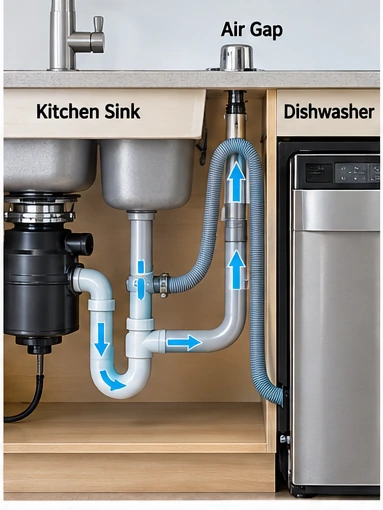
That shared path explains the symptom. The sink may look normal most of the day because faucet water drains gradually. During a dishwasher drain phase, however, the pump can deliver water much faster. A partially restricted line may not accept that surge, so the water level rises into the sink.
Kitchen Sink Backs Up When Dishwasher Runs? Match the Exact Pattern
Do not treat every dishwasher-and-sink problem as the same failure. The pattern tells you which section of the plumbing deserves attention first.
| What you see | Start here | Why |
|---|---|---|
| Sink is normal until the dishwasher drains | Shared kitchen drain downstream of the connection | A partial restriction may handle faucet flow but not the dishwasher’s pumped discharge. |
| Sink is already slow without the dishwasher | P-trap / kitchen branch drain | The drain is showing symptoms even before the dishwasher adds more water. |
| Problem started after a new garbage disposal | Dishwasher inlet knockout plug | A retained plug can block dishwasher discharge at the disposal inlet. |
| Water sprays from the air gap | Air gap and the hose/path after it | GE says air-gap overflow can point to blockage in the downstream hose or sink/disposal connection. |
| Dirty sink water ends up inside the dishwasher | High loop / air gap / downstream drain | Backflow protection or a clogged shared drain needs attention. |
| Dishwasher will not drain, but the sink drains normally | Dishwasher drain hose/filter/pump path | The restriction may be appliance-specific rather than in the shared sink drain. |
| Several fixtures back up or gurgle | Shared branch or main drain | The problem may extend beyond the kitchen. |
The Most Useful Clue: A Partial Kitchen Drain Clog
A partial clog is different from a completely blocked sink. Grease, food debris, soap residue, and hardened buildup can narrow the pipe without sealing it shut. That is why the sink may appear acceptable during light use but back up when the dishwasher suddenly discharges several liters of water.
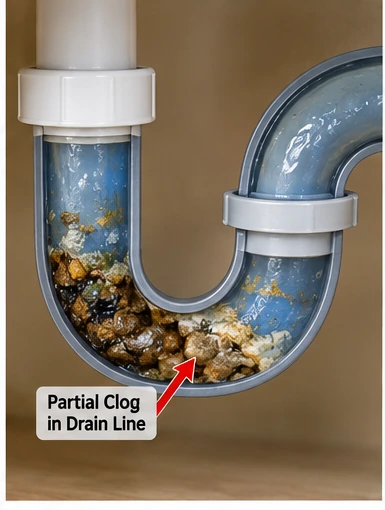
Simple flow test
With the dishwasher off, run the kitchen faucet and watch how quickly the sink clears. Then note what happens when the dishwasher reaches its drain phase.
If the backup is limited to the kitchen and you are comfortable with basic plumbing, a removable P-trap can sometimes be inspected with a bucket underneath after the area is made safe. But if the blockage is deeper in the wall, keeps returning, or affects more fixtures, professional drain cleaning is the better next step.
GE specifically advises against using drain cleaner in the dishwasher, and harsh chemicals in a shared sink/disposal line can create splash and handling hazards during later disassembly. Mechanical cleaning or professional drain service is the safer diagnostic path.
New Garbage Disposal? Check the Knockout Plug First
This is one of the most valuable checks because it can look exactly like a dishwasher drainage failure. New disposals ship with the dishwasher inlet sealed. If a dishwasher is connected, that plug must be removed during installation.
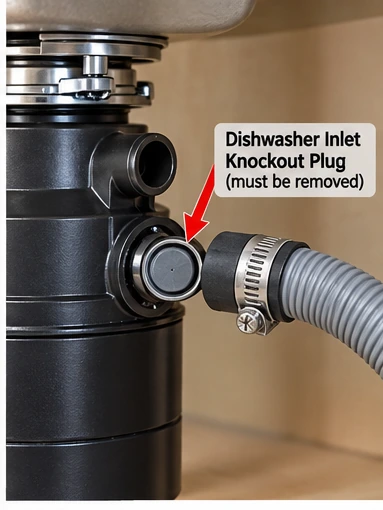
Whirlpool lists a retained disposal knockout plug as a common reason a newly installed dishwasher will not drain. InSinkErator also instructs installers to remove the dishwasher knockout plug before connecting the hose.
If the problem began immediately after replacing or installing the garbage disposal, check the installation before assuming the dishwasher pump suddenly failed at the same time.
If you need to inspect the disposal connection, disconnect power to the disposal at the plug or breaker first. Never place your hand inside the grinding chamber. If you are not comfortable confirming the inlet setup, use a plumber or appliance installer.
If the disposal itself hums, jams, or will not run, use our Garbage Disposal Not Working guide rather than treating it as only a drain-line problem.
If the Air Gap Spits Water, Do Not Ignore It
An air gap is the small fitting mounted near the faucet on some installations. GE explains that it is part of the plumbing, not the dishwasher itself, and that it helps prevent water from a clogged drain from backing into the dishwasher.
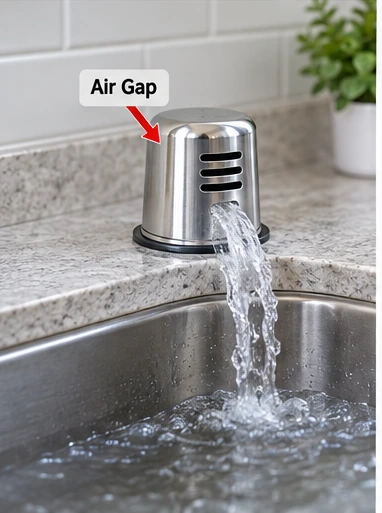
GE’s cleaning guidance specifically says to inspect the air gap for debris and check the hose from the air gap to the sink drain or garbage disposal for blockage. Whirlpool similarly notes that if water spills from the air gap during a drain cycle, the restriction is downstream in the hose-to-drain path or sink plumbing.
If your air gap is designed for homeowner cleaning, lift the decorative cap and follow the appliance/plumbing instructions for clearing accessible debris.
The short hose from the air gap to the disposal or sink tailpiece can kink, clog, or become restricted.
If the air gap is clear but water still overflows, the disposal inlet, trap, or kitchen branch drain may be unable to accept the discharge.
What the High Loop Does — and What It Does Not Do
A high loop is the section of dishwasher drain hose secured high under the countertop before it drops to the sink drain or disposal connection. GE and Whirlpool both use a high loop as a backflow/siphoning control when an air gap is not part of the installation.
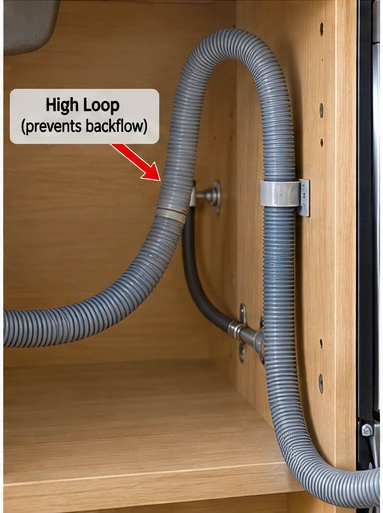
A missing or incorrect high loop can contribute to dirty water returning into the dishwasher. But if the sink itself rises when the dishwasher pumps out, a downstream restriction can still be the real cause. Do not “fix” the hose routing and assume a clogged branch drain has disappeared.
Follow the installation instructions for your specific dishwasher. GE commonly specifies a 32-inch high loop from the floor on many built-in models when no air gap is used, while Whirlpool’s requirements can vary by installation. The model manual is the final authority.
Check the Dishwasher Drain Hose and Sink Connection
The drain hose can also cause trouble before the water even reaches the shared kitchen drain. Whirlpool recommends checking for kinks, crushing, sagging, and debris at the hose end and disposal or tailpiece inlet.

Look for a tight bend behind the dishwasher or under the sink that reduces the hose opening.
Food buildup can collect where the dishwasher hose meets the disposal or tailpiece.
Without the required high loop or air gap, backflow into the dishwasher becomes more likely.
If the sink is normal and the dishwasher alone retains water, shift the diagnosis back toward the appliance drain system.
If your dishwasher fills normally but does not wash or circulate water, that is a different problem. Use our Dishwasher Fills With Water but Won’t Wash guide instead.
Use the Backflow Location to Narrow the Blockage
The final diagnostic step is to ask where the water is going when it cannot move forward. A backup into the sink means the discharge is reaching at least part of the under-sink plumbing. Water inside the dishwasher after sink use points more strongly toward backflow protection and shared-drain conditions.
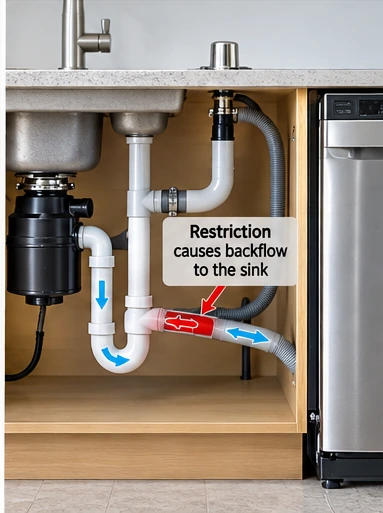
A slow sink before the dishwasher runs is strong evidence of an existing kitchen-drain restriction.
If the sink rises exactly when you hear the dishwasher pump out, focus on the shared downstream route.
A newly installed disposal, moved drain hose, or new air-gap connection can point to a setup problem rather than a suddenly failed appliance.
If toilets, tubs, or another sink also react, the restriction may be beyond the kitchen branch.
If other fixtures gurgle or back up, compare those symptoms with our Toilet Gurgles When Shower Runs guide. Multiple fixtures reacting together changes the diagnosis.
Safe Checks You Can Do Before Calling a Plumber
Keep the first round of troubleshooting simple. The goal is to identify the section of the drain path—not to dismantle half the kitchen.
A disposal full of food waste can slow the shared drain connection. If the disposal is jammed or only hums, stop and diagnose the disposal separately.
Follow the manufacturer’s normal homeowner-cleaning instructions and check the downstream hose for obvious obstruction.
Look for crushing, kinks, a fallen high loop, loose clamps, or an obvious leak under the sink.
Use a bucket, protect the cabinet, and restore all slip-joint washers correctly. Stop if piping is corroded, glued, or difficult to access.
Disconnect electrical power before touching any disposal plumbing or connection. Never put a hand inside the disposal chamber, even when the switch is off.
How Much Can Professional Drain Cleaning Cost in 2026?
If the restriction is beyond the P-trap or keeps returning, professional drain cleaning is often the sensible next step. Angi’s 2026 data puts typical professional drain cleaning around $147–$352, averaging about $246. A simple sink clog can be near the lower end, while deeper, recurring, or main-line work can cost more.
| Situation | Typical planning cost | What changes the price |
|---|---|---|
| Accessible sink/P-trap issue | Often low DIY cost | Replacement washers, trap parts, or simple cleaning if you can safely access it. |
| Professional household drain cleaning | About $147–$352 | Angi 2026 range; location and clog severity matter. |
| Typical average drain-cleaning job | About $246 | Useful planning figure, not a quote. |
| General plumbing service | Often $182–$501 | Broader plumbing repairs vary by scope and local rates. |
| Main-line or recurring blockage | Can be substantially higher | Camera inspection, hydro jetting, access, or pipe damage increase cost. |
Do not pay for a dishwasher pump replacement just because water appears during the drain cycle. The diagnostic value of this symptom is that it can point to the shared kitchen plumbing instead.
Call a Plumber or Technician If…
Frequently Asked Questions
Why does my kitchen sink fill with water when the dishwasher drains?
The dishwasher usually shares the kitchen sink’s downstream drain. If that pipe is partially restricted, the pumped discharge can arrive faster than the drain can accept it, so water rises into the sink.
Does a sink backup mean the dishwasher pump is bad?
Not usually. If the dishwasher is actively pumping enough water to raise the sink, the drain pump may actually be doing its job. The restriction can be after the hose joins the sink plumbing.
Why did this start after I installed a new garbage disposal?
Check the dishwasher inlet knockout plug. Whirlpool and InSinkErator both identify removal of that plug as necessary when connecting a dishwasher to a new disposal.
Why is water coming out of the dishwasher air gap?
The air gap itself may contain debris, or the hose/path after the air gap may be restricted. GE recommends checking the air gap and the hose running from it to the sink drain or disposal.
Will adding a high loop stop the kitchen sink from backing up?
A correct high loop helps prevent dirty sink water from flowing back into the dishwasher, but it will not clear a clogged P-trap or branch drain. If the sink itself rises during the drain cycle, investigate the downstream plumbing too.
Should I use chemical drain cleaner?
It is safer to avoid harsh chemical cleaners in a dishwasher-connected drain system, especially if you may later disconnect the trap or hoses. Mechanical cleaning or a plumber is a better choice for a persistent restriction.
Technical References & 2026 Cost Sources
This article was cross-checked against current dishwasher installation/troubleshooting guidance and 2026 drain-cleaning cost data. Always follow the installation manual for your exact dishwasher and disposal model.
- Whirlpool — Dishwasher Not Draining
- Whirlpool — Checking the Drain Loop Height
- GE Appliances — Cleaning the Dishwasher Air Gap
- GE Appliances — Preventing Sink Water Backflow Into Dishwasher
- InSinkErator — Installing a New Garbage Disposal / Dishwasher Knockout Plug
- Angi — Drain Cleaning Cost [2026]
- Angi — Plumbing Repair Cost [2026]