
Dishwasher Fills With Water but Won’t Wash? Use the Sound After Filling to Find the Cause
If water enters the tub but the dishes never get sprayed, what you hear next can separate a low-fill problem from a blocked spray arm or a circulation-pump problem.
When a dishwasher fills with water but won’t wash, the inlet valve has already done at least part of its job. The next question is whether the machine can circulate that water. Listen after the fill stops, check whether the spray arms actually move, and confirm there is enough water before assuming the wash pump has failed.
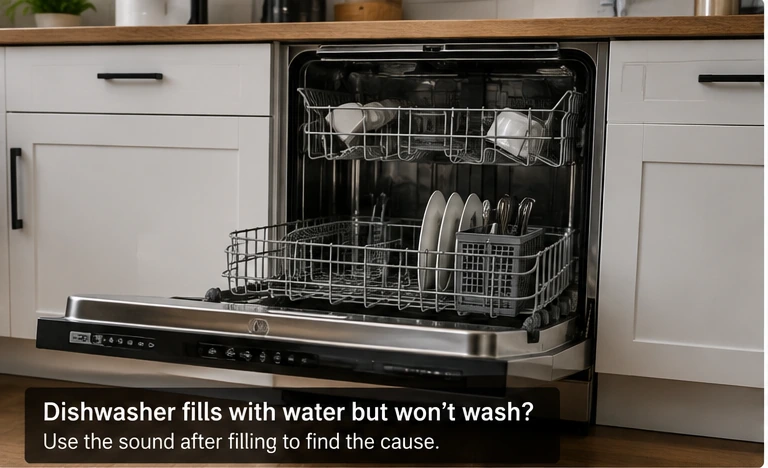
First, Listen to What Happens After the Dishwasher Fills
A dishwasher does not wash simply because there is water in the bottom. During the wash portion of the cycle, a circulation or wash pump sends that water through the spray system. The spray arms then use water pressure to rotate and distribute water across the racks. If that circulation step never happens, the machine can look as if it started normally—lights on, water in the tub, timer advancing—while the dishes remain almost untouched.
Do not judge the machine during a brief pause. Some modern dishwashers intentionally stop and restart the wash pump and may alternate water between different spray arms. GE, for example, documents systems where the pump pauses for several seconds and supplies different arms at different times. Listen through more than one short pause before deciding that the wash motor is not running.
Circulation is happening. If cleaning is still poor, move toward blocked spray arms, loading, filters, low pressure to one rack, or a wash-zone setting.
The wash system may be trying to run without moving water normally. A restricted pump, impeller problem, low water level, or wash-motor fault becomes more plausible.
Confirm that it is not a normal programmed pause. If the wash phase should be active and there is still no circulation, a control, wiring, or wash-pump problem may need service.

“It has water” and “it is washing” are two different observations. Your first goal is to prove whether the water is being circulated, not to guess which part needs replacing.
Quick Diagnosis: Match the Symptom to the Next Check
Use the table as a starting point, not as a parts list. Dishwasher designs vary, and one symptom can have more than one cause.
| What you notice | Most useful interpretation | Check next |
|---|---|---|
| Fills, then strong spraying starts | The circulation pump is moving water | Spray-arm blockage, loading, filter, rack-specific wash path, detergent/cycle issues |
| Fills, then hums but there is no obvious spray | Wash system may be energized but not circulating normally | Water level, filter/pump restriction, impeller or wash-pump problem |
| Fills, then stays quiet through the expected wash phase | Wash motor may not be starting, but rule out programmed pauses | Error code, reset, model-specific wash-motor/control diagnosis |
| Spray arm never changes position | It may be blocked, starved of water, or not receiving circulation pressure | Hand-spin test, nozzle check, water level, repeat movement test |
| Only one rack stays dirty | Whole-machine pump failure is less certain | That rack’s spray arm, docking connection, diverter/wash-zone behavior, loading |
| Water is present but looks unusually shallow | The dishwasher may fill, but not with enough water for normal wash pressure | Compare level with the owner’s manual; check supply and fill system |
| Detergent door opens but pod remains mostly intact | Weak or absent spray may be preventing proper detergent use | Confirm circulation and spray-arm movement before blaming detergent |
Do This Safe Spray-Arm Movement Test Before Buying a Pump
This simple test is more useful than staring through the closed door. It tells you whether the wash system is creating enough water movement to reposition the spray arm.
Make sure no utensil, cutting board, pan handle, or rack item hangs into a spray arm. With the machine off, gently rotate the accessible arms by hand. They should move freely without hitting the load.
Point one end toward a memorable position. You do not need to mark the arm or modify anything.
Wait until the fill sound stops and the wash phase should have begun. Give the machine time to move past any normal pause.
The door switch should stop operation when the door is opened. Keep your face and hands back from hot steam and splashing water. Never defeat the door latch or run the machine with a safety switch bypassed.
If it moved and the tub is wet, circulation is occurring. If it has not moved, close the door and repeat after another wash interval because some models alternate spray arms rather than running all of them continuously.
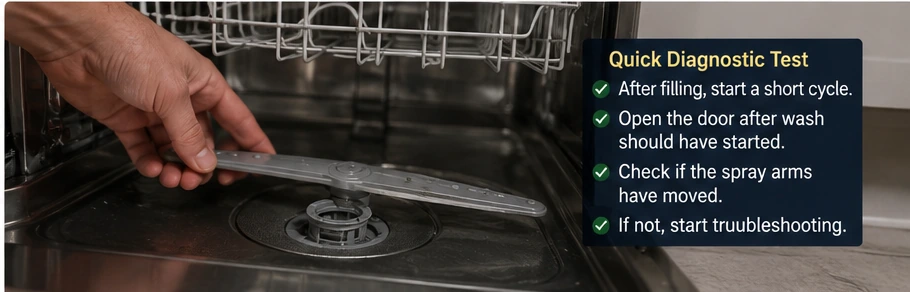
Do not reach into a running dishwasher, bypass the door switch, or perform live-voltage tests for this guide. Disconnect power at the plug or breaker before removing service panels or touching internal electrical parts.
There Is Water in the Tub—but Is There Enough?
A partial fill can be deceptive. You open the door, see water, and conclude that the inlet side is fine. But a dishwasher can receive some water without reaching the level its wash system needs. GE notes that insufficient fill can prevent a spray arm from spinning properly, and its support documentation gives model-specific water-level checks. That is why a universal “the water should be exactly this many inches deep” rule is not reliable across every dishwasher.

If the level looks unusually low, check the simple external conditions first: make sure the water supply valve is fully open, the inlet hose is not kinked, and other heavy household water use is not reducing supply during the test. GE specifies that low water pressure can reduce fill and wash performance; exact pressure and level requirements should come from the model’s documentation.
If the dishwasher consistently underfills, the inlet valve, float/level sensing system, supply restriction, or another fill-system problem may require diagnosis. At that point, the fact that “some water entered” should not push you toward replacing the circulation pump.
If You Hear Water Moving, Check the Spray Arms Before the Pump
Strong rushing or splashing after the fill is evidence that the wash pump is doing something. If the dishes still look untouched, look for a mechanical reason the water is not reaching them effectively.
Whirlpool, KitchenAid, Bosch, and GE all tell owners to make sure spray arms can rotate freely and that their nozzles are not blocked. Tall utensils, pans, cutting boards, or items hanging below a rack can physically stop an arm. Food particles and mineral deposits can also restrict the small jet openings.
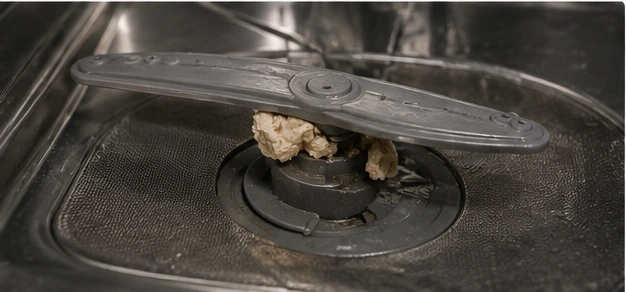
Check three things
- Free rotation: with the dishwasher off, spin each accessible spray arm by hand and look for contact with dishes or rack items.
- Open nozzles: follow the owner’s manual for removing the arm if needed, then rinse it and clear visible debris without enlarging or damaging the jet holes.
- Correct cycle or wash zone: some machines have top-rack-only or zone options. Whirlpool notes that a top-rack-only selection can intentionally leave the lower spray arms inactive.
If only the top or bottom rack is affected while the other rack washes normally, that pattern is especially useful. It makes a total loss of circulation less likely and shifts attention toward the affected arm, its feed path, rack docking connection, diverter, or model-specific wash-zone behavior.
What the Circulation Pump Actually Does
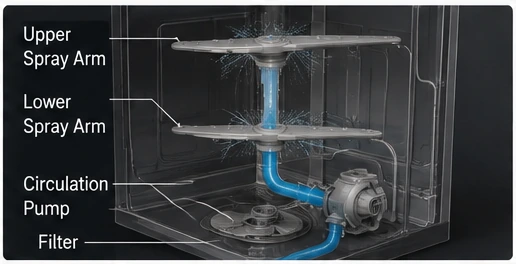
The circulation pump is different from the drain pump. The drain pump removes dirty water from the tub. The circulation or wash pump takes water already inside the dishwasher and sends it through the wash system. A dishwasher can therefore fill correctly and drain correctly yet still fail to wash if the circulation side is not working.
Some brands expose wash-motor faults as error codes. Whirlpool, for example, identifies F7E2 on supported models as a wash motor error and recommends a power cycle followed by service if the code returns. Do not assume that code applies to another brand or even every Whirlpool model; always use the code chart for your exact model.
Fills, Then Hums or Buzzes but Does Not Spray
A hum after filling is more informative than silence, but it still does not prove which component failed. It may mean a motor is energized but cannot turn normally, the pump is restricted, an impeller is damaged or jammed, or the machine does not have enough water to circulate properly. The exact architecture varies by model.
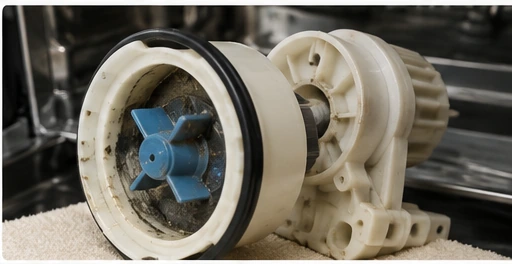
Start with the checks that do not require electrical disassembly: water level, filter condition, free spray-arm movement, visible nozzle blockage, and any error code on the display. If your owner’s manual provides an owner-accessible filter or pump-cover cleaning procedure, follow that procedure exactly. Bosch, for example, publishes owner cleaning instructions for filters and certain pump areas, but access differs across models.
If those checks do not restore circulation, a technician may need to determine whether the wash motor is receiving the correct electrical command and whether the pump assembly is mechanically sound. That is a better point to consider a pump replacement than the moment you first notice dirty dishes.
Fills, Then Goes Quiet
First make sure the “quiet” period is actually abnormal. Energy-efficient dishwashers can pause, sense, alternate spray zones, and change pump speed during a cycle. GE specifically documents brief wash-pump stops as normal on some alternating-spray systems.
If you wait through the expected wash period and there is still no spray sound, no spray-arm movement, and no evidence of circulation, check the display for an error and try the manufacturer’s normal reset or power-cycle procedure. A persistent no-wash condition with correct fill can involve the wash motor, control, wiring, door/latch signal, or another model-specific circuit.
Control-board and motor-voltage diagnosis exposes mains-powered components on many dishwashers. If the basic owner checks are complete and the wash motor never starts, use manufacturer service or a qualified appliance technician rather than probing energized wiring.
Can a Dirty Filter Cause This Symptom?
A dirty filter is a common reason for poor washing, but it is important not to oversell it. A dirty filter does not explain every dishwasher that fills and then produces absolutely no wash action. It matters most when debris is restricting the recirculation path, contaminating the wash water, or contributing to reduced spray performance.
Remove and clean the filter only according to your model’s instructions. Bosch recommends regular filter cleaning and warns that accumulated food and debris can affect the filter and pump. While the filter is out, inspect the accessible area for obvious debris, but do not reach blindly into a pump cavity—broken glass and sharp fragments can collect there.
The Best Troubleshooting Order
The goal is to avoid replacing a circulation pump when the real problem is a blocked arm or low fill—and to avoid spending an hour cleaning spray holes when the wash motor never starts at all.
The dishwasher fills, but you do not get normal wash action afterward.
Strong spray, hum/buzz, or sustained silence send the diagnosis in different directions.
Make sure dishes and utensils are not physically blocking the arms.
Check whether the arm changes position after a real wash interval. Repeat because some machines alternate arms.
If it seems low, use model-specific guidance before blaming the wash pump.
Follow the manual and keep the machine powered off during maintenance.
Use the manufacturer’s code chart for the exact model. Do not transfer codes from one brand to another.
If fill is correct, arms are clear, and there is still no circulation, the wash pump/motor, control, or related hardware deserves professional diagnosis.
What Not to Replace First
Do not buy a circulation pump simply because the dishwasher contains water and the dishes are dirty. “Not cleaning well” is broader than “not circulating at all.” If you can hear strong spray, see that the arms moved, and find the interior thoroughly wet, the pump is already producing circulation and you should investigate spray distribution, loading, filters, water temperature, detergent, and model-specific wash features.
Likewise, do not replace the inlet valve just because the spray arms are not moving. First determine whether the fill level is actually low. The best repair decision comes after separating fill, circulation, and distribution into three different stages.
When to Call a Technician
Professional diagnosis makes sense when the dishwasher fills to a normal level but never develops wash circulation after the basic checks, when a wash-motor error returns after the manufacturer’s reset procedure, when the machine repeatedly trips a breaker, or when accessing the suspected pump requires electrical or under-tub disassembly beyond the owner’s manual.
Also stop if you find a burnt smell, melted connector, water leaking into the base, damaged wiring, or evidence that water has reached electrical components. Those conditions are no longer a simple spray-arm troubleshooting job.
Frequently Asked Questions
Why does my dishwasher fill with water but not start washing?
If the fill completes but there is no wash action, first listen for the circulation pump and check whether the spray arms move. Correct fill with no circulation can point toward a wash-pump/motor, control, wiring, or model-specific fault, but normal pauses and alternating spray-arm operation should be ruled out first.
How do I know if the dishwasher circulation pump is working?
During the wash phase you should normally hear water moving and see evidence of spray inside the tub. A spray arm that changes position after a wash interval is another useful clue. Some dishwashers alternate arms, so repeat the check before concluding that one arm is inactive.
Can a dishwasher have water but still be underfilled?
Yes. Visible water only proves that some water entered. An insufficient fill can reduce wash pressure and spray-arm movement. Use the owner’s manual or manufacturer guidance for the correct water level on your model.
Why does my dishwasher hum after filling but not spray?
A hum with no obvious circulation can be associated with a restricted or stalled wash system, low water level, an impeller problem, or a wash-motor fault. Check water level, filters, spray arms, and error codes before replacing the pump.
Does a spray arm have to spin continuously?
No. Some dishwashers alternate water between spray arms or pause the wash pump during the cycle. An arm that is stationary at one moment is not enough to prove a fault.
Can blocked dishes stop a dishwasher from washing?
They can stop a spray arm from rotating and leave part of the load dirty even though the circulation pump works. Spin the arms by hand before starting the cycle and rearrange anything that interferes with a full revolution.
Final Thoughts
When a dishwasher fills but does not seem to wash, resist the urge to jump straight to the circulation pump. Listen after the fill, prove whether the spray arms move, and check whether the machine has enough water. Those three observations separate many simple wash-distribution problems from a true loss of circulation.
If you hear healthy spraying, troubleshoot where the water goes. If you hear only a hum, look at water level and restrictions before the pump itself. If the machine stays quiet through the real wash phase, check codes and model-specific reset guidance before moving into electrical diagnosis. That order gives you a much better chance of fixing the cause instead of replacing the first part that sounds plausible.
Technical References
Dishwasher wash systems vary by brand and model. The diagnostic sequence above was cross-checked against manufacturer guidance on circulation, spray-arm movement, water level, wash-motor errors, and cleaning.
- GE Appliances — Circulation System With Alternating Spray Arms
- GE Appliances — Lower Spray Arm Not Spinning
- GE Appliances — Dishwasher Not Washing Properly
- Whirlpool Product Help — Spray Arm Not Working
- Whirlpool Product Help — F7E2 Wash Motor Error
- Bosch — How to Clean Dishwasher Spray Arms
- Bosch — Dishwasher Not Cleaning Dishes