
Garbage Disposal Not Working? Use the Sound to Find the Cause
No sound, humming, sudden shutdown, and intermittent operation point to different problems.
If your garbage disposal is not working, do not assume you need a new unit. What you hear when you flip the switch is one of the fastest diagnostic clues. Complete silence usually sends you toward power and overload protection, while a disposal that hums but does not grind is more likely jammed.
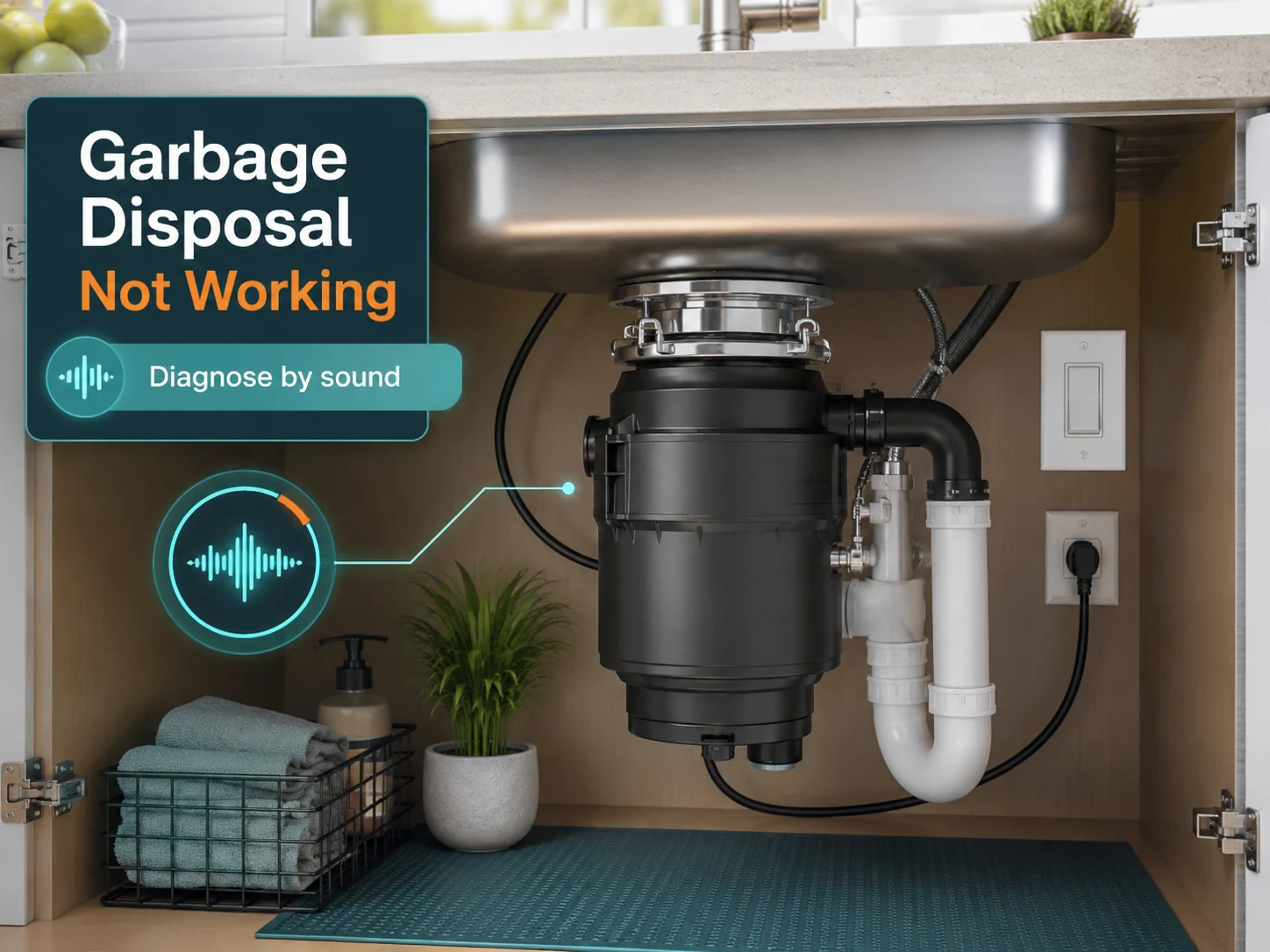
Turn the wall switch off before inspecting the unit. If you will use tongs, pliers, or a disposal wrench, unplug the disposal when possible or turn off the correct breaker. Use a flashlight and tools for visible debris — never your fingers.
Start With What the Garbage Disposal Is Doing
The phrase garbage disposal not working can describe several completely different failures. Turn the unit on only long enough to identify the symptom, then switch it back off.
Quick Garbage Disposal Diagnosis
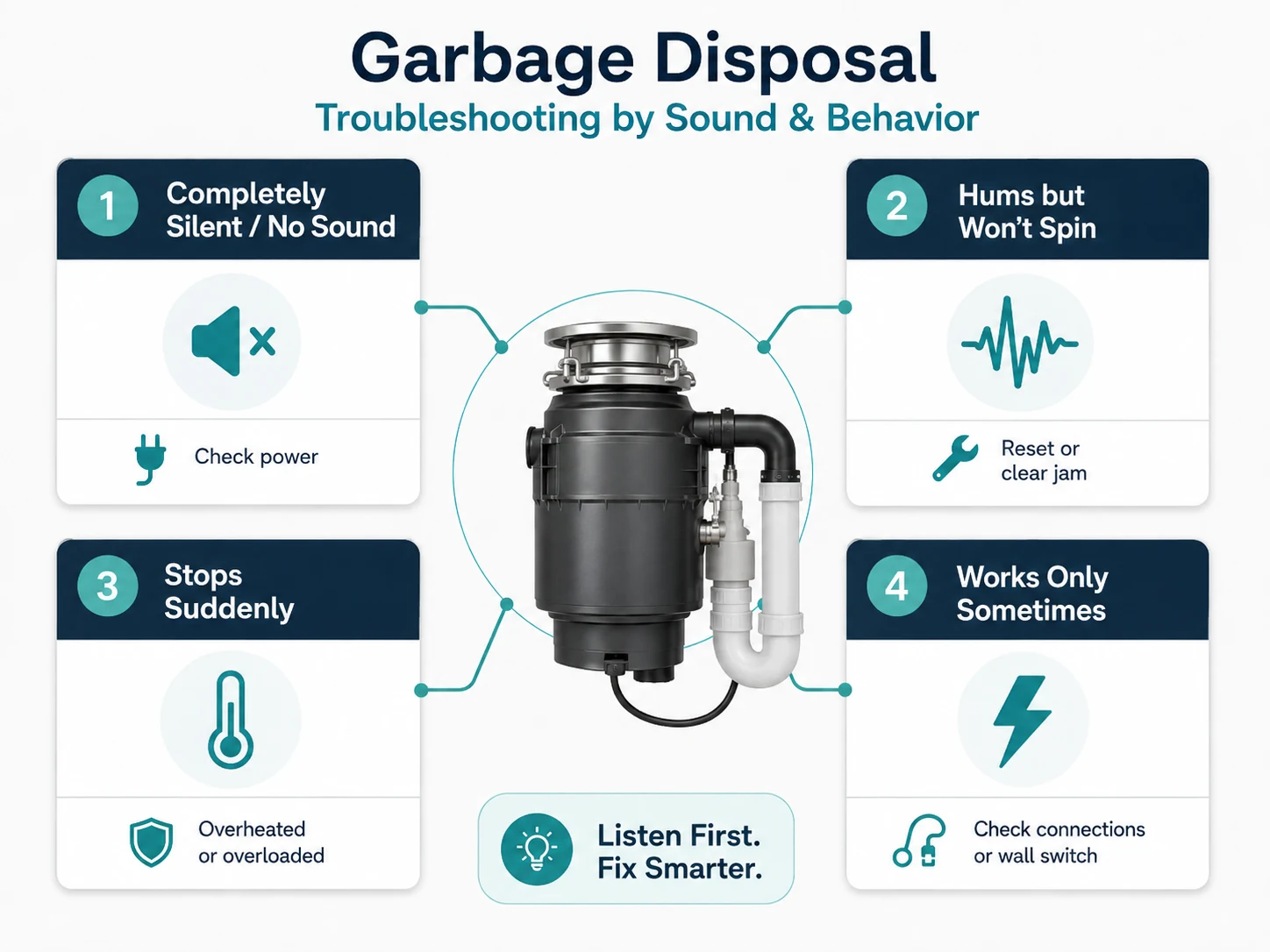
Use this table to choose the first safe direction before removing parts or calling for service.
| What You Notice | Most Likely Direction | First Safe Check | Cost Direction |
|---|---|---|---|
| Completely silent | Power, overload protector, breaker, outlet, or wall switch | Reset → breaker → outlet / switch | Often $0 if it is a simple reset or power interruption |
| Hums but does not grind | Mechanical jam | Disconnect power and check for an obstruction | Often $0 DIY if the jam is safely cleared |
| Runs, then stops | Overload protection, overheating, or recurring jam | Turn off → cool → inspect → reset | Often $0 if the overload was temporary |
| Works only sometimes | Intermittent power, switch, overload, or motor problem | Notice whether failed attempts are silent or humming | Professional diagnosis may be worthwhile |
Garbage Disposal Not Working With No Sound? Start With Power
Complete silence is a useful clue. If you flip the switch and hear no hum, click, or motor noise, start with the electrical supply and overload protection instead of trying to force the grinding mechanism.

Leave the disposal off while you perform the initial power checks.
Many traditional garbage disposals have a small red reset button on the bottom of the unit. If the motor overheated, allow it to cool before following the reset procedure for your model.
Look for the breaker serving the disposal or kitchen circuit. If it has tripped, reset it once. If it trips again, stop and have the electrical fault investigated.
Unplug the disposal first. Plug an appropriate small device into the outlet to confirm whether it receives power.
If another device also fails to respond to the wall switch, the problem may be in the switch, outlet, or household wiring rather than the disposal.
If the disposal has confirmed power and the overload protector is not tripped, but the unit remains completely silent, an internal electrical or motor failure becomes more likely.
Do not remove live electrical connections or perform internal voltage testing unless you are qualified. Hardwired disposal, outlet, switch, cord, and motor faults may require professional service.
Garbage Disposal Humming but Not Spinning? Check for a Jam
Humming changes the diagnosis. The disposal is receiving power, but the motor cannot turn the grinding mechanism normally. A mechanical jam is one of the first things to check.
Switch the unit off promptly. Leaving a stalled motor humming can cause overheating and trip the overload protector.
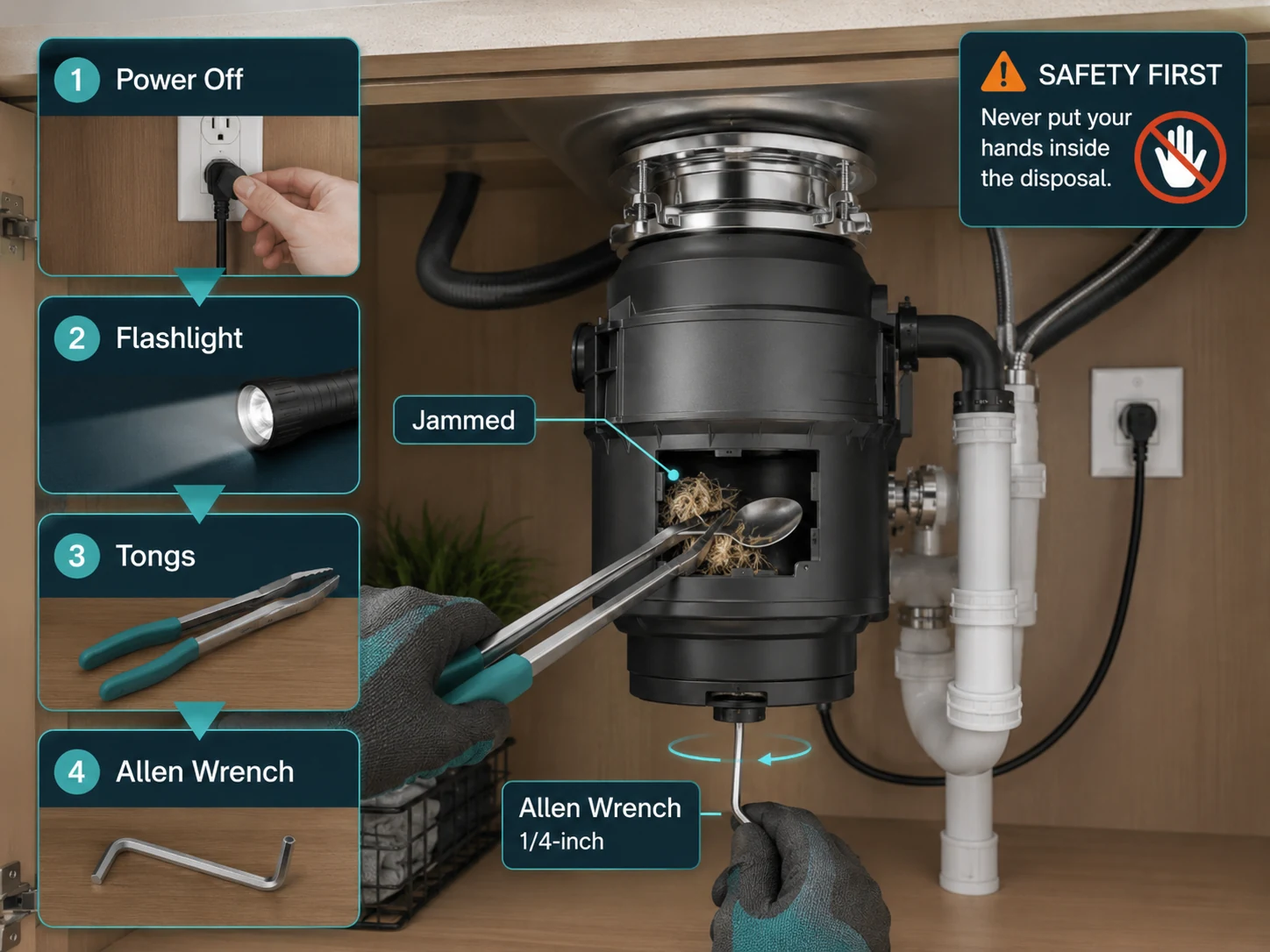
Turn the wall switch off. Unplug the disposal when possible. If it is hardwired, switch off the correct circuit before putting tools near the unit.
Check for obvious foreign objects such as metal, glass, plastic, hard debris, bones, or part of a utensil.
Never reach inside with your fingers, even when the wall switch is off.
Many InSinkErator-style disposals have a center hex opening on the bottom. A supplied self-service wrench or standard 1/4-inch Allen wrench can be used on compatible models.
Move it gently in both directions until the grinding mechanism turns freely.
Check the chamber again with a flashlight and remove any loosened debris with tongs.
If the stalled motor overheated, let it cool and follow the reset procedure for the exact model.
If your disposal does not have one, do not force an Allen wrench into the housing. Check the manufacturer instructions for that model.
What if the wrench turns freely but the disposal still hums?
If the mechanism turns freely and no obstruction remains, yet the disposal still produces only a hum, the problem is less likely to be a simple jam. A motor or internal starting fault becomes more likely.
Humming with a mechanism that will not turn strongly supports a jam. Humming after the mechanism already moves freely is a stronger reason to consider professional diagnosis or replacement.
Garbage Disposal Starts Normally but Suddenly Stops
A disposal that starts and then suddenly goes dead may have activated its overload protection. A jam, heavy load, or extended run time can overheat the motor enough for the protector to interrupt operation.
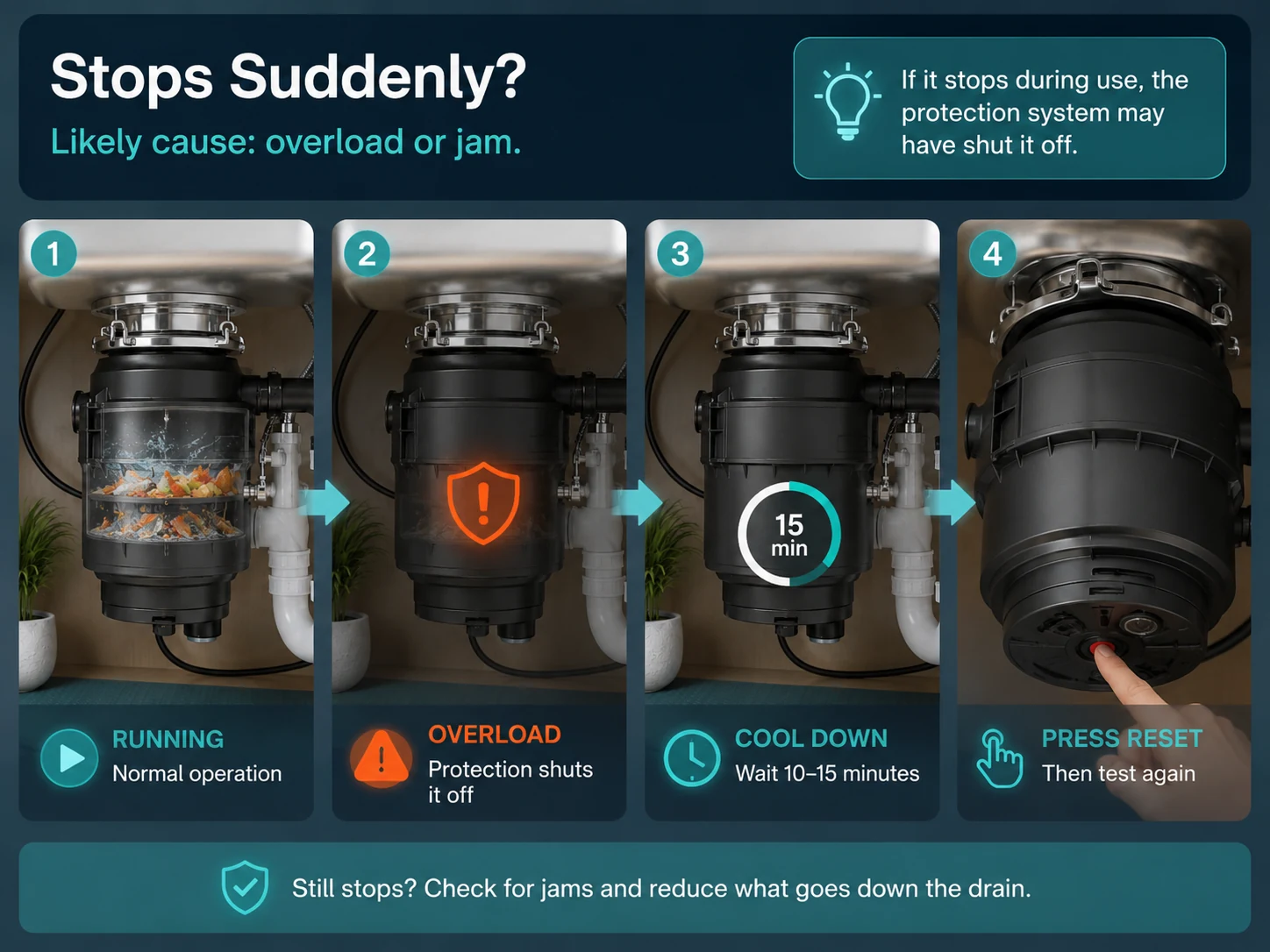
Do not keep cycling the disposal on and off after a sudden shutdown.
Depending on the design and how hot it became, the unit may need roughly 10 to 20 minutes before it can operate again.
If an obstruction caused the overload, resetting the unit without removing it will only recreate the same problem.
Restore power only after the mechanism is free and every tool has been removed.
If the disposal now works normally and stays running, the shutdown may have been caused by a temporary overload or jam.
If the grinding mechanism is free but the disposal repeatedly trips its overload protection, an aging motor or internal electrical problem becomes more likely.
Garbage Disposal Works Only Sometimes
Intermittent problems are easier to narrow down when you note exactly what happens on the failed attempt. The difference between silence and humming is especially useful.
Overheating or overload protection becomes more likely, especially if it works again after cooling.
Return to the jam and motor diagnostic path rather than treating it as a simple loss of power.
Focus on the reset protector, switched outlet, wall switch, breaker, or another power-supply issue.
A worn switch or electrical connection becomes more suspicious. Do not open live wiring to test that theory.
The reset is reacting to another problem. A recurring jam, overheating motor, or electrical fault may still be present.
How Much Does It Cost to Fix a Garbage Disposal?
Repair cost depends on what the diagnosis finds. A simple reset or jam may cost almost nothing, while motor, electrical, or replacement work can move the total into the hundreds of dollars.
Often only a flashlight, tongs, or the correct hex wrench is needed.
A useful U.S. average. Actual diagnosis and labor charges vary.
The unit, horsepower, labor, plumbing, and electrical work affect the total.
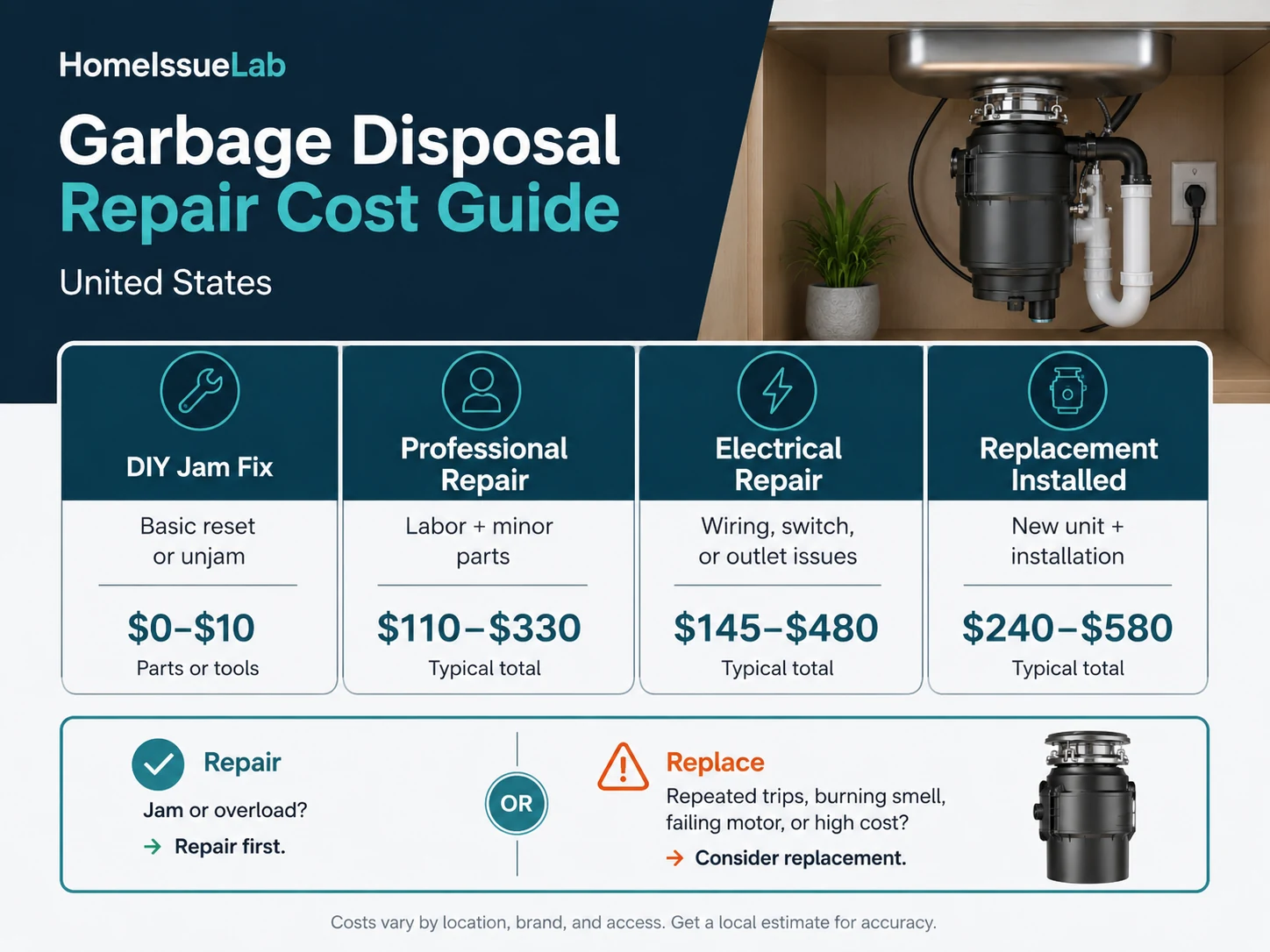
A tripped overload protector, lost outlet power, or simple jam can sometimes restore a garbage disposal without replacing any parts.
Repair or Replace the Garbage Disposal?
When a garbage disposal is not working, replacement should not be the first assumption. Combine the symptom, age of the unit, and estimated repair cost.
Repair First When
- The mechanism is simply jammed.
- The overload protector tripped once.
- The issue is a simple breaker, outlet, or switch problem.
- The disposal otherwise runs normally.
- Repair cost is clearly below replacement cost.
Consider Replacement When
- The motor hums even though the mechanism turns freely.
- The overload repeatedly trips after jams are cleared.
- There is a burning smell or visible heat damage.
- The disposal housing itself is leaking or damaged.
- An older unit needs a major repair close to replacement cost.
What if the Disposal Runs but the Sink Does Not Drain?
If the disposal sounds normal and spins, but water remains in the sink, the main problem is no longer whether the disposal turns on. A drain blockage, trap obstruction, or plumbing restriction becomes more likely.
A disposal that leaks from the bottom or around the mounting flange also needs a leak-specific diagnosis rather than the power and jam checks in this guide.
Stop Using the Disposal if You Notice These Signs
These symptoms go beyond a routine reset or jam. Do not keep flipping the wall switch to see whether the disposal eventually starts again.
How to Reduce Future Garbage Disposal Jams
Garbage disposal recommendations vary by model, but a few operating habits can reduce unnecessary jams and overloads.
- Run cold water while the disposal is grinding.
- Continue the water for several seconds after grinding finishes.
- Keep grease and cooking fat out of the disposal and drain.
- Never place glass, metal, plastic, or utensils into the grinding chamber.
- Avoid forcing a large amount of food waste into the unit at once.
- Follow any restrictions in the manual for your specific disposal.
A slower grinding sound, humming, or obvious strain is a reason to switch the unit off and investigate rather than feeding it more waste.
Frequently Asked Questions
Why is my garbage disposal not working at all?
If it is completely silent, check the overload or reset protector, breaker, wall switch, and outlet first. If confirmed power reaches the disposal but it remains silent, an internal motor or electrical issue becomes more likely.
Why is my garbage disposal humming but not spinning?
Humming normally means the motor has power but the grinding mechanism cannot move. A mechanical jam is one of the first causes to check.
Where is the garbage disposal reset button?
Many traditional models have an overload reset button on the bottom of the unit. Some newer models use automatic overload protection instead.
Can I use a 1/4-inch Allen wrench to unjam a garbage disposal?
Many compatible InSinkErator units accept a standard 1/4-inch Allen wrench in the bottom hex opening. Other disposal designs may use a different procedure.
Why does my garbage disposal keep stopping after I reset it?
A recurring jam, overheating motor, or internal fault may still be causing the overload protection to trip. Repeated resetting is not a repair.
How much does garbage disposal repair cost?
A simple reset or jam may cost almost nothing. Professional repair averages around the low hundreds, while complete replacement can cost several hundred dollars depending on the unit and installation.
Official References
This guide was cross-checked against current manufacturer guidance for disposal jams, overload protection, reset procedures, and units that do not turn on.
- InSinkErator — Fixing a Jammed Garbage Disposal
- InSinkErator — Resetting a Garbage Disposal
- InSinkErator — Garbage Disposal Won’t Turn On or Off
- Angi — Garbage Disposal Repair Cost
- Angi — Garbage Disposal Replacement Cost
Cost figures are broad U.S. estimates for planning only. Actual prices depend on location, disposal model, access, labor rates, and electrical or plumbing work required.
Final Thoughts
When a garbage disposal is not working, start with what the unit actually does. Complete silence points toward power and overload protection. Humming points toward a jam. A sudden shutdown suggests overload or overheating, while intermittent operation needs closer attention to whether failed attempts are silent or humming.
Diagnose that pattern before buying parts. A simple reset or jam may cost almost nothing to correct, while a disposal with an internal motor failure may be more economical to replace.