
Outside AC Unit Running but No Air Blowing Inside? Check the Indoor Side First
A spinning condenser fan outside does not prove the indoor blower is moving air. Use the vents, thermostat fan test, filter, and coil condition to narrow down the fault.
If the outdoor AC unit is running but you feel little or no air from the vents, do not start by assuming the compressor or refrigerant is the problem. The quickest diagnosis starts indoors: determine whether the blower can run, whether airflow is restricted, and whether ice has blocked the evaporator coil.

When the outside AC unit runs but no air blows inside, the most useful first suspects are on the indoor side: thermostat fan control, air-handler/furnace power, blower motor or capacitor, a severely clogged filter, or a frozen evaporator coil. If only one room has no airflow, think register or duct problem before blaming the blower.
Why the Outdoor Unit Can Run While the House Gets No Air
A typical split AC system has two separate air-moving jobs. The outdoor condenser fan moves outdoor air across the condenser coil, while the indoor blower moves household air across the evaporator coil and through the ductwork. Trane specifically notes that if the condenser fan is operating normally but there is low or no airflow from the vents, the indoor blower motor may be the problem.
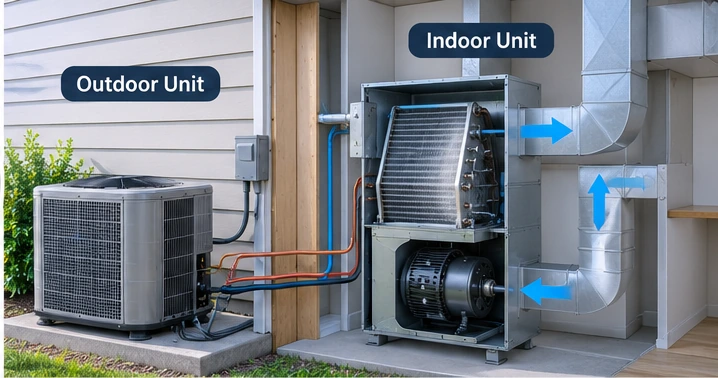
This is why “the AC is running” can be misleading. You may hear the outdoor compressor and fan while the indoor air handler is silent, stalled, restricted, or blocked by ice.
Outside AC Unit Running but No Air Blowing Inside? Start With These Checks
The airflow pattern tells you where to start. Use the behavior that best matches your system instead of checking every possible cause.
Think air-handler/furnace power, thermostat fan call, blower motor, capacitor, control, or door/service-switch issue.
The blower may be trying to run without moving air. Motor, capacitor, wheel, or a mechanical/electrical fault moves higher on the list.
Check the filter, return/supply blockage, frozen coil, blower performance, and duct restriction.
A freezing evaporator coil becomes more plausible, especially if copper tubing or the indoor cabinet shows frost or later leaks water.
The main blower is probably moving air. Check the register, damper, flex duct, branch duct, or local blockage.
This is strong evidence to focus on indoor blower power/control/mechanical issues rather than cooling demand alone.

Do the Thermostat FAN → ON Test
This is one of the safest and most useful homeowner checks. For an outside AC unit running but no air blowing inside, the next useful question is whether the indoor blower can run on its own. Set the thermostat system to a normal mode, then change the fan setting from AUTO to ON and wait briefly.
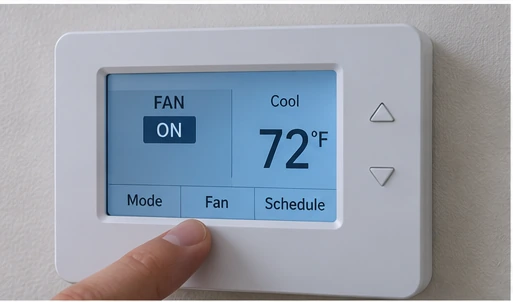
Read the result
Stand at a nearby supply vent after switching FAN to ON. Do not keep cycling settings every few seconds; allow the system time to respond.
If the thermostat itself is blank, restarting, reading the wrong temperature, or not commanding the system correctly, use our Thermostat Not Working guide instead.
Check the Filter Before You Assume the Blower Failed
A severely clogged filter can starve the indoor unit of return air. Carrier identifies a dirty or clogged filter as a common cause of restricted airflow and notes that restricted airflow can contribute to a frozen evaporator coil. A filter problem is simple compared with a motor repair, so it belongs near the top of the diagnosis.
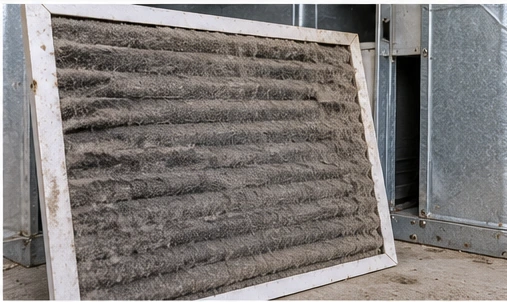
If your filter is in a return grille, follow the manufacturer’s normal replacement procedure. Use the correct size and airflow direction.
Do not install a random high-resistance filter just because it has a higher rating. Use the filter type your system is designed for.
Move furniture or objects blocking large return grilles, and make sure supply registers have not all been closed.
If a fresh filter restores normal airflow, monitor the system. If airflow remains poor or the coil freezes again, the filter was not the whole problem.
Weak Airflow That Gets Worse Can Mean a Frozen Evaporator Coil
Carrier lists poor airflow, inadequate cooling, frost on refrigerant tubing, and water around the indoor unit as signs of a frozen evaporator coil. Common triggers include restricted airflow from a dirty filter or blocked vents, a fan problem, dirt on the coil, and refrigerant issues.

Turn COOL off. Carrier advises allowing the coil to thaw naturally and warns against using hair dryers or space heaters to speed the process. Continuing to run a frozen system can put extra strain on the compressor.
After the ice melts, inspect the easy airflow causes: filter, blocked returns, and closed supply registers. If the coil freezes again, call an HVAC professional. Refrigerant charge, leaks, coil condition, and internal blower/electrical faults require proper diagnosis.
Melting ice can produce a temporary surge of condensate. If water appears around the indoor unit, also make sure the condensate drain is not overflowing. Persistent water leakage deserves its own diagnosis.
When the Indoor Blower Becomes the Main Suspect
Lennox identifies no air from the vents as the clearest sign that an air handler is not running. If thermostat FAN = ON produces no airflow, the filter is not severely clogged, and there is no ice physically blocking the coil, the blower system deserves more attention.

Listen before you assume the motor is dead
- Completely silent indoor unit: power, control signal, board, safety/door switch, wiring, or motor may be involved.
- Hum or buzz without airflow: a motor/capacitor or mechanical problem becomes more plausible.
- Grinding, scraping, or repeated starts/stops: shut the system down and arrange service rather than letting the blower damage itself.
Capacitors can retain dangerous electrical energy even after power is removed. Live-voltage testing, capacitor testing, control-board work, and blower-motor replacement belong with a qualified HVAC technician.
Check Indoor-Unit Power Without Opening Electrical Compartments
The outdoor unit and indoor unit can lose power independently. A homeowner-safe check is limited to external controls and normal-access items. Do not remove electrical covers.
Look for a clearly tripped breaker. If it trips again after one reset, leave it off and call for service.
These often look like a normal light switch near the indoor unit and can be turned off accidentally.
Many systems use a door interlock that prevents blower operation when the panel is not installed correctly. Do not bypass the switch.
If you have to remove an electrical cover, bypass a switch, or measure live voltage to continue, stop there.
If Only One Room Has No Air, Move Away From the Blower
A failed indoor blower normally affects many or all supply vents. If most rooms have normal airflow but one room does not, the issue is more likely downstream: a closed register, balancing damper, crushed flex duct, disconnected branch, blockage, or duct leak.
Check only what you can see safely. Do not crawl into unsafe attic spaces or cut ductwork open. Carrier notes that hidden duct leaks generally require professional diagnosis because much of the duct system is inaccessible.
How Much Can This Repair Cost in 2026?
Cost depends on what the diagnosis actually finds, the motor type, system accessibility, local labor rates, warranty coverage, and whether refrigerant or ductwork is involved. Current 2026 Angi data puts average blower-motor replacement around $560, with much wider ranges on complex ECM or hard-to-access systems.
| Possible repair | 2026 planning range | What to know |
|---|---|---|
| Dirty filter / basic airflow correction | Usually low DIY cost | Use the correct filter size/type and restore blocked returns/registers. |
| Blower capacitor | About $200–$400 installed | Angi’s 2026 capacitor guide says labor drives most of the total. Do not DIY-test a capacitor if you are not qualified. |
| Blower motor | Average around $560 | PSC, ECM, horsepower, access, and warranty can move the total substantially. |
| General blower/fan motor repair | About $200–$700 in broad HVAC cost data | A useful budget range before the exact motor and failure are known. |
| Refrigerant leak | About $250–$1,500 | Leak diagnosis and refrigerant work require an HVAC professional. |
| Evaporator coil replacement | About $600–$2,400 | Only relevant if the coil itself is confirmed failed—not just because it froze once. |
| Duct repair | About $500–$2,000 | Varies widely with location, access, and damage. |
These are planning ranges, not quotes. A frozen coil caused by a $20–$40 filter problem is very different from a failed ECM blower motor or refrigerant leak. Diagnose first, then price the confirmed repair.
Stop Troubleshooting and Call an HVAC Professional If…
An outside AC unit running but no air blowing inside usually sends the diagnosis toward the indoor airflow side first. Check FAN = ON, the filter, signs of a frozen evaporator coil, indoor-unit power, and whether the problem affects one vent or the whole house before assuming the outdoor condenser or refrigerant system is at fault.
Frequently Asked Questions
Why is my outside AC unit running but nothing is blowing from the vents?
The outdoor condenser can run while the indoor blower does not. Start with thermostat FAN = ON, indoor-unit power, the filter, and signs of a frozen coil. If those checks do not restore airflow, the blower motor/capacitor or control system may need service.
Can a dirty air filter cause no airflow?
A severely clogged filter can reduce airflow dramatically and can contribute to evaporator-coil freezing. If the coil becomes heavily iced, airflow may fall even further. Replace a clogged filter with the correct type, but investigate further if airflow does not return.
Should I set the thermostat fan to ON if there is no airflow?
Yes, as a diagnostic test. If FAN = ON produces airflow, the blower is capable of running. If it produces no airflow, focus more strongly on the indoor blower, power, control, or a severe restriction.
What should I do if the AC coil is frozen?
Turn cooling off and allow the coil to thaw naturally. Do not use a hair dryer or space heater. Check easy airflow causes such as the filter and blocked vents. If the coil freezes again, call an HVAC professional.
Can one blocked vent mean the blower motor is bad?
Usually no. If other rooms have normal airflow, the main blower is moving air. A closed register, branch duct, damper, disconnected duct, or local restriction is more likely.
Is it safe to replace an HVAC blower capacitor myself?
Not for an untrained homeowner. Capacitors can retain dangerous electrical energy. This guide does not recommend opening electrical compartments or testing/discharging capacitors.
Technical References & 2026 Cost Sources
This guide was cross-checked against current manufacturer troubleshooting guidance and 2026 repair-cost data. Exact procedures and parts vary by HVAC model.