
Toilet Gurgles When the Shower Runs? Use the Other Drains to Find the Blockage
The toilet is often where you hear the problem—not where the problem starts.
If your toilet gurgles when the shower runs, use the shower speed, nearby sinks, other toilets, and any backup to work out whether you are dealing with a local branch drain, a venting problem, or a deeper main drain issue.

When your toilet gurgles when the shower runs, the toilet itself is usually not the first thing to replace. Water moving through a shared drain can expose a partial restriction or a pressure/venting problem, and the toilet trap becomes the place where that pressure change is heard. If the shower is also slow, a shared branch restriction moves higher on the list. If several fixtures react—or water rises in a tub, shower, or floor drain—treat it as a deeper drain or sewer warning.
Do not keep flushing toilets, running the shower, starting laundry, or using the dishwasher to “see what happens.” A gurgle can precede a backup. Once water or sewage starts coming up through another fixture, additional water use can make the overflow worse.
Toilet Gurgles When the Shower Runs: Why It Happens
A bathroom is not a collection of completely separate pipes. The shower, toilet, and sink eventually connect into shared drainage piping. At the same time, the drain-waste-vent system must move air so wastewater can flow without pulling or pushing excessively on fixture traps.

King County describes a plumbing trap as a fitting that provides a liquid seal when properly vented, helping prevent the back passage of air while allowing wastewater to flow. The CDC’s Healthy Housing Reference Manual also explains that pressure differences in waste lines can disturb trap seals and that proper venting is used to control those pressure problems.
This is why replacing toilet tank parts is usually the wrong first move. A flapper, fill valve, or chain controls flushing and refilling inside the toilet tank; it does not correct a restriction farther down a shared drain. If your problem is actually a toilet that keeps running after a flush, use our separate toilet keeps running diagnostic guide.
Quick Diagnosis: One Bathroom or the Whole House?
Before touching a drain tool, map the symptoms. The most useful question is not simply “Why is my toilet gurgling?” It is which fixtures react when water moves through the plumbing system? That tells you how far downstream to look.
A partial restriction in the bathroom branch becomes more likely, especially if the nearby sink is also slow.
Venting or pressure imbalance stays on the list, but do not call it a blocked vent until broader drain symptoms are ruled out.
Move the search deeper toward a building drain, main sewer line, or—on septic homes—the onsite wastewater system.
That is a backup symptom, not just a noise complaint. Stop adding water and arrange a drain/sewer inspection.

A gurgle tells you air and water are interacting abnormally somewhere in the drainage path. The pattern across fixtures is what makes that sound useful.
Shower Drains Slowly + Toilet Gurgles: Suspect the Shared Branch First
This combination is one of the most useful patterns. The shower sends water into the bathroom branch, but a partial restriction reduces the space available for both water and air. The toilet may gurgle even though it still flushes because its trap is reacting to the pressure change created downstream.
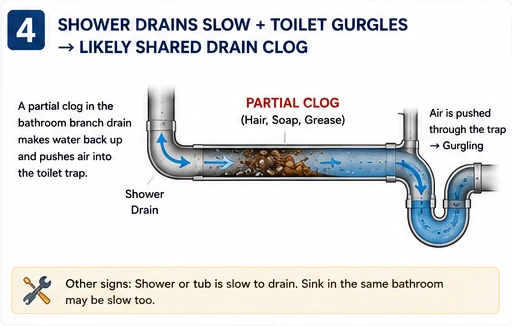
Clues that keep the problem near this bathroom
- The shower is noticeably slower than it used to be.
- The toilet gurgles mainly while that shower is draining.
- A nearby bathroom sink may drain slowly, but fixtures elsewhere in the house remain normal.
- There is no wastewater appearing in a lower tub, shower, floor drain, or toilet.
What you can safely do
If the shower itself is slow and the problem appears limited to this bathroom, start at the shower drain—not the toilet tank. Remove an accessible strainer and clear visible hair or soap buildup that can be reached without dismantling concealed plumbing. Then run a modest amount of water and see whether the shower speed improves and the toilet gurgle disappears.
The restriction may be farther downstream where the shower and toilet connect. If the surface is clean but the same pattern returns, repeated chemical treatments are not a diagnosis; the branch may need mechanical clearing or inspection.
Shower Drains Normally + Toilet Gurgles: Venting Becomes More Plausible
If the shower moves water at a normal speed, other drains are not slow, and there is no backup, a venting or pressure-balance issue deserves more attention. The plumbing vent provides a path for air as wastewater moves through the system. A restriction, poor vent configuration, or another pressure problem can make a trap bubble or gurgle.

Gurgling without widespread slow drains keeps a venting problem on the list because air pressure may be changing even though water still moves through the drain.
A partial drain restriction can also create pressure changes. Check the rest of the fixtures before paying for roof-level vent work.
- Do not pour chemicals or objects down a roof vent.
- Do not run a powered auger from a roof without the correct equipment and fall protection.
- Do not assume a vent is blocked simply because the toilet makes one gurgling sound.
A plumber can separate a vent problem from a drain restriction by combining fixture behavior with access-point inspection, mechanical clearing, and—in stubborn or recurring cases—camera or other diagnostic work.
Multiple Fixtures React: Move the Search Toward the Main Drain or Sewer
When the symptoms spread beyond one bathroom, stop treating the toilet as the center of the problem. A restriction farther downstream can affect several branches because all of them eventually need the same path out of the house.

Warning pattern
- More than one toilet gurgles.
- Sinks, tubs, showers, or laundry drains have become slow at roughly the same time.
- Flushing a toilet makes water rise or bubble in a lower shower or tub.
- The problem returns soon after a local drain was cleared.
- You see or smell wastewater at a floor drain or other low fixture.
The City of Norman, Oklahoma, specifically notes that a gurgling toilet may indicate that a sewer backup is occurring. That does not mean every gurgle is a failed sewer line, but it is why a spreading pattern should be taken more seriously than a single noisy fixture.
EPA lists gurgling plumbing, slow tubs/showers/sinks, and wastewater backing up into household plumbing among signs of a failing septic system. If several fixtures are affected and the home is on septic, the problem may be beyond the indoor branch piping. Avoid excessive water use and have the onsite system evaluated if the symptoms fit.
Avoid contact with sewage. EPA advises that sewage backups can contain harmful pathogens. Stop unnecessary water use and contact an appropriate plumbing, sewer, septic, or local utility professional based on where the problem is found.
Final Diagnostic Flow: Follow the Clues in This Order
If you remember only one part of this guide, use this sequence. It prevents you from jumping straight from “toilet gurgles” to “blocked vent” or “bad sewer line” without checking the evidence in between.

Start with accessible shower debris and a likely bathroom branch restriction. If clearing the shower entrance does not change the pattern, the branch may need professional snaking.
Venting becomes more plausible. Document when the gurgle happens and whether any trap water level changes, then have the drain/vent layout checked if it persists.
Move toward the building drain, main sewer, or septic system rather than treating each fixture separately.
Do not continue diagnostic water tests. Prevent overflow and arrange professional service.
Safe Checks You Can Do Without Making the Problem Worse
The goal is to gather information, not force water through a system that may already be close to backing up. Use small, controlled checks and stop as soon as a backup appears.
Does water pool around your feet or take longer than normal to disappear? A slow shower plus toilet gurgling is more useful than the sound by itself.
Run it briefly. If it is also slow or makes the toilet react, the issue is less likely to be limited to hair sitting directly under the shower strainer.
If a second toilet, tub, or sink is also slow or gurgling, stop focusing on the first bathroom and move the diagnosis toward a deeper shared drain.
Lower tubs, showers, and floor drains can reveal a deeper backup first. If water rises there when another fixture drains, stop using water.
If the shower is slow, remove visible hair or buildup at an accessible strainer. Do not dismantle concealed piping or open a sewer cleanout unless you know how to manage a pressurized backup safely.
- Do not keep flushing repeatedly when another fixture is rising.
- Do not mix drain-cleaning chemicals or add chemicals to standing wastewater.
- Do not use a powered sewer auger without the training and equipment to control it.
- Do not open a main cleanout if backed-up wastewater may be under pressure.
- Do not climb onto a wet or steep roof to inspect a vent.
What Might the Repair Cost?
The cost depends much more on where the restriction is and how it must be cleared than on the fact that the toilet gurgles. A reachable bathroom branch is a very different job from tree roots or damage in a buried sewer line.
| Likely service | Typical 2026 cost context | When it fits this symptom |
|---|---|---|
| Professional drain cleaning | About $147–$352 | Localized or moderate drain clog; actual price changes with location and severity. |
| Main sewer clog clearing | About $380 average; roughly $99–$1,600 across simple to major jobs | Several fixtures react, backups occur, or the blockage is in the main line. |
| Sewer camera inspection | About $200–$1,300 in Angi’s 2026 main-line cost data | Recurring clogs, suspected damage/roots, or when the blockage location is not clear. |
| Hydro jetting | Commonly about $350–$600 for a professional cleaning visit | Heavy buildup or stubborn sewer-line blockage after the pipe condition and blockage are assessed. |
These are U.S. budgeting ranges, not quotes. Access, emergency service, pipe condition, location, and the clearing method can change the total substantially.
A camera or hydro jet can be valuable for the right problem, but a symptom limited to one slow shower may not need the same service as a recurring whole-house sewer backup. Diagnosis first; method second.
When to Stop Troubleshooting and Call a Plumber
DIY checks are useful while the problem is limited and no wastewater is backing up. Stop when the risk of overflow, sewage exposure, pipe damage, or an inaccessible blockage becomes more important than the value of another test.
This is an active backup clue. Stop adding water.
The problem may be in a deeper shared drain or sewer line.
Recurring symptoms can justify camera inspection for roots, damage, belly, or persistent buildup.
Avoid direct contact and prioritize containment and professional service.
Roof access and powered clearing tools add fall and injury risk.
The onsite system may need inspection rather than another indoor drain treatment.
Frequently Asked Questions
Can a clogged shower drain make the toilet gurgle?
Yes, if the restriction is in a section of drainage piping shared by the shower and toilet. But hair sitting only at the shower strainer does not automatically explain toilet gurgling. The stronger clue is a slow shower combined with toilet noise while other parts of the house remain normal.
Does a gurgling toilet always mean the vent is blocked?
No. Venting problems can disturb trap pressure, but partial drain restrictions can create similar symptoms. Check whether the shower is slow and whether other fixtures react before deciding the roof vent is the cause.
Why does my toilet bubble when I drain the bathtub or run the shower?
The larger flow of water can change air pressure in a shared drain. If that path is restricted or poorly vented, air may move through the toilet trap and make the bowl bubble or gurgle.
Should I keep flushing to see if the clog clears?
No if water is rising in another fixture or the toilet is close to overflowing. Repeated flushing adds more water to a drainage system that may already be blocked.
Can a main sewer clog start with only gurgling?
It can. The City of Norman notes that a gurgling toilet may indicate a sewer backup is occurring. One gurgle is not proof of a main-line clog, so look for stronger clues such as multiple slow fixtures, lower-level backups, or recurring problems.
What if I have a septic tank instead of a city sewer?
Multiple slow drains, gurgling plumbing, or wastewater backups can also be signs of septic-system trouble. EPA lists these among common warning signs. Reduce water use and have the septic system evaluated if the symptoms extend beyond one fixture.
Technical References & Cost Sources
HomeIssueLab uses official plumbing/public-health guidance for the diagnostic and safety principles, with current U.S. cost data used only for budgeting context.
- King County — Waste and Vent Pipe Installation: trap and vent function.
- CDC — Healthy Housing Reference Manual, Plumbing: trap seals, pressure differences, and venting principles.
- City of Norman — Sewer Overflows: gurgling toilets as a possible backup warning.
- U.S. EPA — Frequent Questions on Septic Systems: slow drains, gurgling, and backups as septic warning signs.
- U.S. EPA — Resolving Septic System Malfunctions: sewage-backup safety and inspection context.
- Angi — Drain Cleaning Cost, 2026: current U.S. budgeting range for professional drain cleaning.
- Angi — Main Sewer Line Clog Repair Cost, 2026: main-line clearing and camera-inspection cost context.
- Angi — Hydro Jetting Cost, 2026: current hydro-jetting budgeting range.