
Refrigerator Clicking but Not Cooling? Use the Click Pattern to Find the Cause
The sound matters: one normal click, repeated clicking, and a click → hum → click pattern point in very different directions.
A refrigerator can click during normal operation. The concern is when the clicking repeats and the refrigerator or freezer is getting warm. Instead of replacing parts at random, use the timing, sound sequence, and location of the click to decide whether you are dealing with a normal control sound, a fan problem, a compressor start problem, or a wider cooling failure.
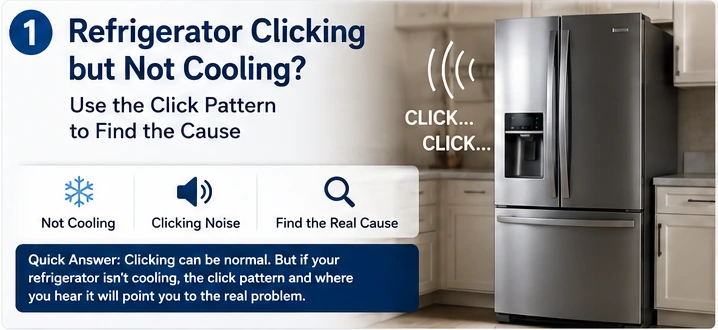
Use an appliance thermometer if you have one. The FDA recommends keeping the refrigerator at 40°F (4°C) or below and the freezer at 0°F (-18°C). During a power failure, keep the doors closed. If perishable food has been above 40°F for 2 hours or more, FDA guidance says to discard it rather than judge safety by smell or appearance.
Quick Diagnosis: Start With the Click Pattern
Do not begin by assuming the compressor has failed. First answer three questions: Does the refrigerator still cool? How often does it click? and where does the sound come from? Those clues are more useful than the word “clicking” by itself.
If temperatures are normal, this may simply be a control, relay, defrost, valve, or compressor-related operating sound.
Give the refrigerator time. GE says compressor restart clicking after a power outage can last about 3–5 minutes.
The compressor may be trying to start and dropping out. Start components, supply conditions, or the compressor itself need model-specific diagnosis.
Treat this as a real cooling failure. Protect the food, confirm power, then focus on the compressor/start path and cooling system.
If the sound changes when a door opens or is joined by scraping, a fan or ice interference may be more likely than a compressor start fault.
That is a different diagnostic path. Airflow, evaporator frost, fan, or damper problems deserve attention before compressor-start parts.
Use our dedicated Refrigerator Not Cooling but Freezer Works guide. That symptom usually needs an airflow-focused diagnosis rather than the clicking/start-system path on this page.
Normal Click or Warning Click? Separate Them First
Refrigerators are not silent appliances. Controls switch, valves move, fans and compressors cycle, and materials expand or contract as temperatures change. LG describes clicking from relay or control operation as a normal sound, and Samsung notes that a compressor can make some clicking as it runs. The sound becomes more meaningful when it is paired with a loss of cooling.
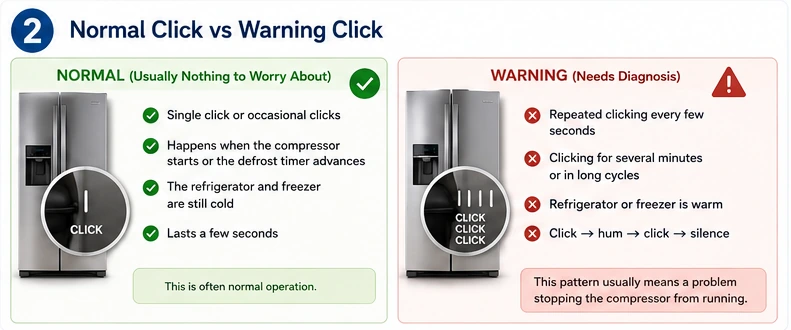
A brief click around a cooling or defrost cycle can be normal. Do not replace a relay, thermostat, control board, or compressor because of one isolated sound when the refrigerator is cooling correctly.
Repeated attempts, especially with humming or long silent periods between attempts, deserve troubleshooting. The sound now has a second clue: cooling has stopped.
GE specifically notes that the compressor may click while trying to restart after an outage and that this can last 3–5 minutes. If normal cooling resumes, that short restart period alone does not prove a failure.
Click → Hum → Click → Silence: What That Pattern Means
This is the pattern that deserves the most attention. A click may be followed by a short hum as the compressor attempts to start, then another click as the start or overload protection opens, followed by silence. The cycle may repeat after the system has had time to reset.

Compressor manufacturer Embraco lists a compressor that hums but trips the overload protector as a condition that can involve start components, low voltage, excessive pressure, or an internal compressor problem. In other words, the sound sequence narrows the diagnostic area, but it is not a license to buy a start relay blindly.
A qualified technician may need to distinguish a faulty start device or overload protector from a power-supply problem, control/inverter issue, or a compressor that is electrically or mechanically unable to start. The correct test depends on the model and compressor design.
The compressor area can involve mains voltage, stored capacitor energy, hot components, and the sealed refrigerant system. This guide stops at observation and safe external checks. Internal electrical testing should follow the manufacturer’s service information and be performed by someone qualified to do it safely.
Where Is the Click Coming From?
The location of the sound can save time. Stand beside the refrigerator during the noise and listen without removing panels. A click from the lower rear of the cabinet belongs to a different group of components than a scraping or tapping sound from inside the freezer.

Repeated clicking from the lower rear while both compartments warm up moves the compressor, start device, overload protection, inverter/control path, and supply conditions higher on the list.
Clicking, ticking, scraping, or rhythmic contact inside the freezer can come from a fan touching ice or another obstruction. The exact fan layout varies by model.
Try a door-open sound check
If the sound is clearly inside the freezer, open the freezer door when it happens and listen for a change. On many refrigerators, an evaporator fan stops or changes behavior when a door switch is activated. If the noise changes immediately, that is useful evidence for the technician or for model-specific troubleshooting. Do not defeat or bypass a safety or door switch.
Do not confuse ice-maker sounds with a cooling failure
Ice makers, water valves, and moving ice can produce clicks, knocks, or short mechanical sounds. If the refrigerator is maintaining 40°F or below and the freezer is near 0°F, an occasional interior click is less concerning than repeated lower-rear clicking paired with rising temperatures.
Safe External Checks Before You Call for Service
These checks can rule out simple conditions without opening an energized electrical compartment. Do them in order. If the refrigerator begins cooling normally, monitor temperature rather than continuing to disassemble the appliance.
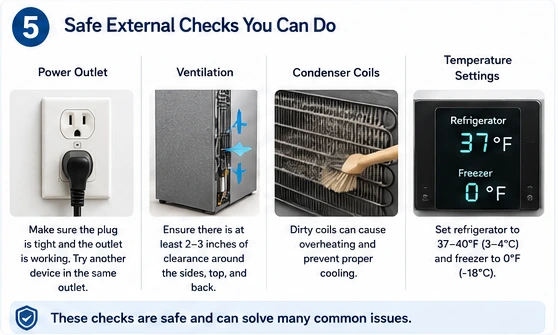
Check that the plug is fully seated and that interior lights or the display behave normally. If the outlet appears dead, use a known working small device only if it is safe and appropriate for that outlet. Repeated breaker trips are a reason to stop, not keep resetting.
Make sure the appliance was not accidentally placed in Demo, Cooling Off, Vacation, or another special mode. Use the model’s manual because the button sequence and display wording vary by brand.
After a brief outage or unplugging, do not cycle power repeatedly. GE says restart clicking can last 3–5 minutes. Other models may use their own compressor-protection delay.
Make sure the refrigerator has the installation clearances specified in its manual and that vents are not blocked by stored items, dust buildup, or a recent move tight against a wall.
If your model has owner-accessible coils or a grille that the manual says to clean, unplug the refrigerator first and follow the manufacturer’s cleaning instructions. Many modern refrigerators do not expose coils in the same way.
Note how often the click repeats, whether a hum follows it, which compartment is warming, the displayed temperatures or error code, and whether the sound began after an outage. Have the model and serial number ready.
What Happens When the Refrigerator Tries to Start?
Traditional compressor systems commonly use a start device and overload protection to help the compressor begin running and protect it if current or temperature becomes excessive. Some designs also use a capacitor. Newer variable-speed or inverter refrigerators can use a different electronic drive system, so the parts shown in a generic diagram do not apply to every model.
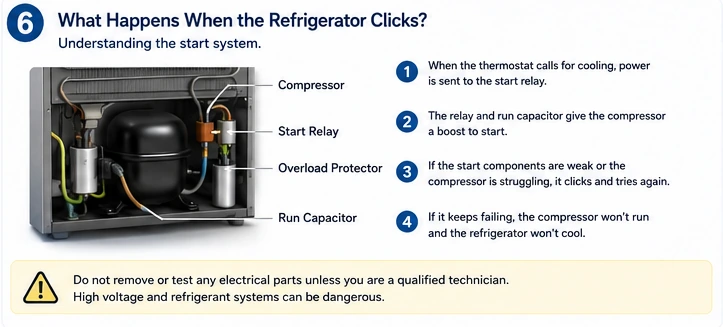
When cooling is requested, the compressor must start against the conditions in the sealed system. A healthy start path gets it running and then leaves the compressor operating normally. If the compressor cannot start, protective components may interrupt the attempt. This is why a repeating click/hum cycle can point toward the start circuit or compressor area.
Embraco notes that a damaged start relay can be associated with a warm refrigerator and clicking, but the same symptom can occur when the compressor itself has a problem or when another electrical/control condition prevents a proper start. Confirm the model-specific diagnosis before ordering parts.
What if the compressor is not the problem?
If the compressor runs steadily but the refrigerator still does not cool, the diagnostic path changes. Fan operation, airflow, frost pattern, controls, refrigerant charge, restriction, or another sealed-system condition may be involved. That is one reason this article starts with the sound and operating pattern rather than a parts list.
Repair Cost: When Does Fixing It Still Make Sense?
Cost depends on the brand, model, accessibility, local labor rate, diagnosis, and whether the repair involves the sealed refrigeration system. Angi’s April 2026 refrigerator guide puts typical refrigerator repairs at about $150–$400, with an average around $275. Its listed component ranges include about $100–$250 for a fan motor, $200–$500 for a control board, and $300–$800 for compressor work.

| Repair direction | 2026 planning range | How to use the number |
|---|---|---|
| General refrigerator repair | About $150–$400 | Useful as a broad benchmark before the exact fault is known. |
| Fan motor | About $100–$250 | More plausible when the compressor runs but airflow or fan operation is abnormal. |
| Control board | About $200–$500 | Do not replace from clicking alone; controls should be diagnosed against the model’s symptoms and service data. |
| Compressor | About $300–$800 in Angi’s general repair guide | Sealed-system labor, refrigerant handling, model design, and warranty can make compressor jobs especially variable. |
Cost source: Angi, updated April 6, 2026. A separate July 2026 Angi compressor guide reports $300–$400 as a common compressor-replacement project range while noting part prices can vary much more widely. Treat all figures as budgeting guidance, not a quote.
Repair or replace?
Check the warranty first, especially if the diagnosis points to the compressor or sealed system. Then compare the confirmed repair quote with the cost and condition of the refrigerator. Angi’s July 2026 repair-or-replace guidance favors repair for a relatively young refrigerator when the fix costs less than about half the replacement price. That is a budgeting rule of thumb—not a technical rule—and a premium refrigerator, an older unit with repeated failures, or a covered compressor can change the decision.
Stop Troubleshooting and Call a Professional If…
Observation and external cleaning are one thing; compressor, capacitor, control, inverter, and sealed-system work are another. Stop the DIY path when the symptom moves into energized components or refrigerant work.
Frequently Asked Questions
Why does my refrigerator click but not start?
A repeating click with no sustained compressor operation can point toward the compressor start path, overload protection, power or control conditions, or a compressor that cannot start. The exact cause cannot be confirmed from the sound alone.
Can a bad start relay make a refrigerator stop cooling?
Yes, on refrigerators that use that type of start device. If the relay cannot start the compressor correctly, the compressor may not run and temperatures can rise. But inverter and variable-speed systems can use different electronics, so identify the model before buying a relay.
Is clicking after a power outage normal?
It can be. GE states that clicking after an outage can come from the compressor trying to restart and may last about 3–5 minutes. If the clicking continues and cooling does not resume, move from “restart delay” to diagnosis.
Can ice around a fan cause clicking?
Yes. A fan blade contacting frost or another obstruction can make ticking, clicking, scraping, or rhythmic contact sounds. If the sound is clearly from inside the freezer and changes when the door opens, fan or frost interference becomes more plausible.
Should I unplug and plug the refrigerator back in repeatedly?
No. Repeated power cycling can make diagnosis harder and does not repair a failed component. After a normal power interruption, give the refrigerator time to complete its restart delay. If it keeps trying and failing to start, document the pattern and arrange model-specific diagnosis.
How do I know if I should use this guide or the “freezer works” guide?
Use this guide when clicking is a major symptom and the refrigerator is failing to cool, especially if both compartments are warming. If the freezer remains properly cold but the refrigerator compartment is warm, use the airflow-focused Refrigerator Not Cooling but Freezer Works guide instead.
Technical References & Cost Sources
This guide uses current manufacturer, food-safety, compressor-manufacturer, and 2026 repair-cost references. Always use the owner/service information for your exact model when a procedure differs.
- GE Appliances — Refrigerator: Normal Sounds and Noises Made
- LG USA Support — Clicking Noise
- Samsung Support — Understanding Refrigerator Noises
- Embraco — Refrigerator Compressor Start Relay
- U.S. FDA — Refrigerator Thermometers: Cold Facts About Food Safety
- U.S. FDA — Power Outages: Key Food Safety Tips
- Angi — Refrigerator Repair Cost (2026)
- Angi — Repair or Replace a Refrigerator (2026)