
Washer Drains but Won’t Spin? Find the Cause Before Replacing Parts
The water is gone. The next clue is what happens — or does not happen — when the spin cycle should begin.
If your washer drains but won’t spin, do not start by ordering a motor or control board. First confirm that the tub is actually empty, then use the sound, drum movement, load behavior, and door or lid response to narrow the problem.
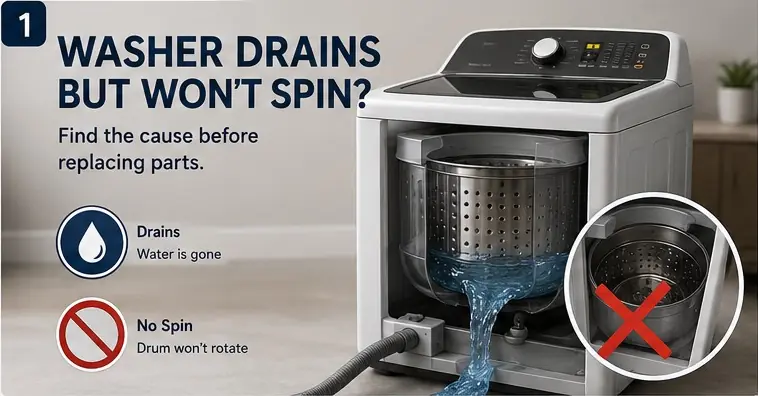
Confirm the Symptom Before You Diagnose the Spin System
This guide is for a washer that pumps the water out but fails to reach a normal high-speed spin. Before checking parts, look inside the tub and confirm that the wash water is actually gone.
If water is still standing in the tub, solve the drainage problem first. A washer that cannot finish draining may never move into its normal high-speed spin stage.
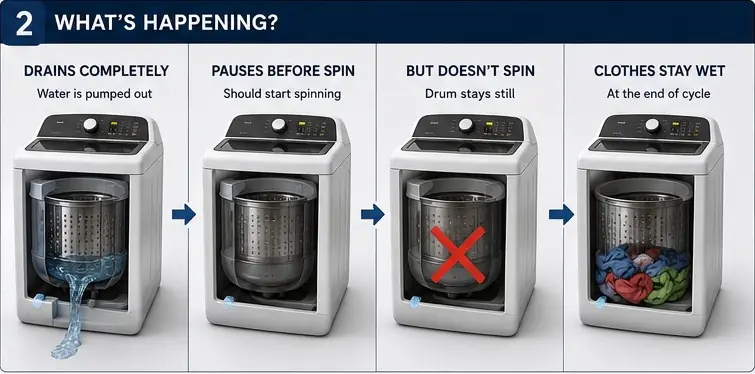
What Happens Right After the Washer Drains?
Do not treat every no-spin complaint as the same failure. Listen and watch for the behavior that best matches your washer.
Do These Simple Checks Before You Suspect a Failed Part
Load balance, washer leveling, cycle selection, and excessive suds can all change how a washer enters or completes spin. Rule these out first because they can mimic a failed part even when the washer is mechanically fine.
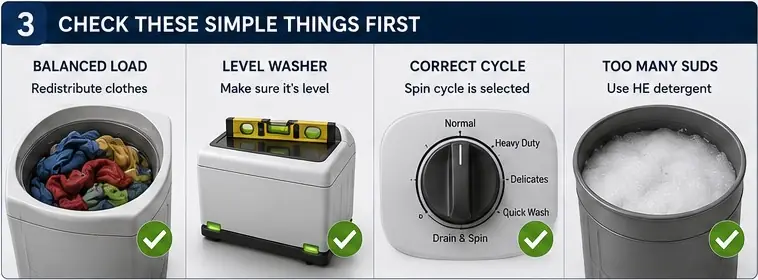
A single heavy towel, blanket, bath mat, or a tightly bunched load can keep the basket out of balance. Remove or redistribute items, then try a Spin or Drain & Spin cycle.
All feet should contact a solid floor. A machine that rocks easily can have more difficulty reaching full spin speed.
Delicate, hand-wash, low-spin, or no-spin settings can leave clothes much wetter than a normal cycle. Test with a cycle that clearly calls for a normal or high spin.
On high-efficiency washers, too much detergent or the wrong detergent can cause extra rinsing and reduced spin speed. Use HE detergent where required and follow the detergent maker’s dose for the load.
Do not bypass a lid switch or door lock. Simply confirm that the lid or door closes normally, nothing is trapped in the opening, and the machine does not show a door or lid error.
Tub Empty, Then Silence: Think About the Lid or Door Signal First
When draining finishes normally but the spin stage never begins, the washer may not be receiving the safety signal it needs to spin. On a top-load washer that can involve the lid switch or lid-lock system; on a front-loader it can involve the door-lock system. The exact design and sequence vary by model.
If the washer repeatedly clicks at the lid or door, displays a lock-related code, or never shows that the door or lid has locked, check the owner’s manual for that model before moving deeper into the machine.
If the lock behaves normally but the washer still becomes completely inactive at spin, the problem can move farther into the control path: wiring, a model-specific actuator or drive component, motor control, or the main control. Those are not parts to replace based on the symptom alone.
Motor Sound or Humming, but the Drum Does Not Accelerate
A humming or running sound changes the diagnosis because the washer may be attempting the spin stage. Depending on the model, possible causes include a worn or broken drive belt, a coupler or clutch-type drive component, a shift actuator, a motor problem, or mechanical resistance in the basket or drum.
Some washers use a belt, some use different couplers or clutches, and some use direct-drive arrangements. A “shift actuator” is also not universal. Use the model number and service information before buying an internal part.
It Starts Spinning, Then Stops, Shakes, or Keeps Rebalancing
This behavior points more strongly toward balance and load control than a washer that never attempts to spin. Whirlpool notes that an out-of-balance load can cause vibration, reduced spin speed, longer cycle times, and in some cases a stopped spin attempt. Samsung similarly recommends checking load distribution and leveling when spin is interrupted.
Try an empty Spin cycle after confirming the washer is level. If it spins normally empty but struggles with one bulky or uneven load, the load itself is a stronger clue. If it shakes violently with ordinary balanced loads, the suspension, leveling, basket condition, or another mechanical issue deserves closer inspection.
The Washer Did Spin, but the Clothes Are Still Very Wet
Very wet clothes do not always mean the washer completely failed to spin. A low-spin setting, a bulky or unbalanced load, or excessive suds can keep the machine from reaching or maintaining its normal extraction speed.
If you can clearly see the drum reach a high speed, focus first on cycle settings, load balance, suds, and whether the machine is repeatedly slowing down to rebalance. If the drum never accelerates at all, follow the no-spin paths above.
Common Causes, Matched to the Clue You See
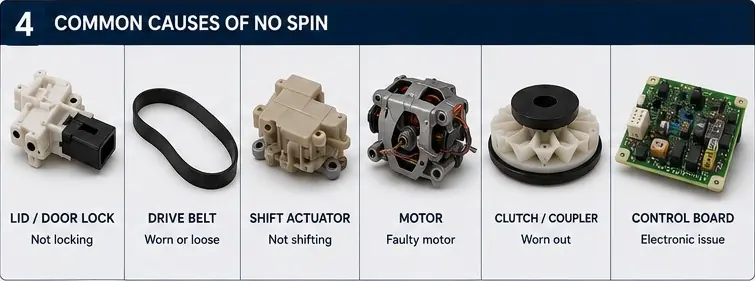
| What you notice | More likely direction | Best first move |
|---|---|---|
| Tub is empty; washer is silent at spin | Lid/door lock signal, cycle/control path | Confirm lock behavior and check model-specific error codes. |
| Motor or humming sound; no drum acceleration | Drive component, motor, or mechanical resistance | Unplug washer, check drum movement, then use the model number before inspecting parts. |
| Spin starts, then stops or retries | Unbalanced load, leveling, suspension/balance detection | Redistribute load and test the machine level and empty. |
| Drum spins but clothes remain very wet | Low spin setting, bulky load, oversudsing, reduced spin speed | Check cycle, load, and detergent use. |
| Drum is hard to turn or grinds when unplugged | Mechanical/internal problem | Stop forcing the drum and arrange model-specific diagnosis. |
With the Washer Unplugged, Check Drum Movement by Hand
Samsung’s current troubleshooting guidance suggests checking whether an empty drum physically turns by hand. This simple observation can separate a control or drive problem from a drum that feels mechanically restricted.
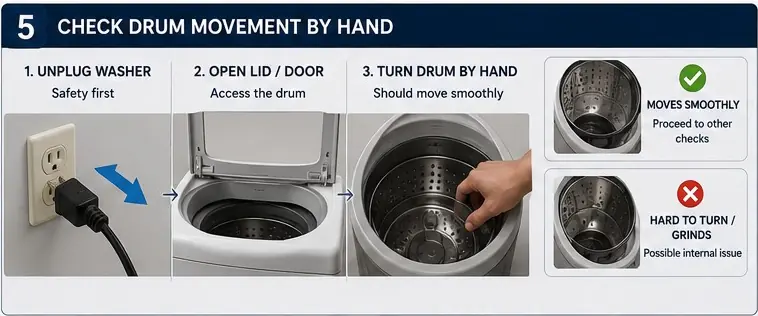
Do not rely on the control panel’s Power button. Disconnect the appliance from the outlet before putting your hand in the drum or basket for this check.
Some resistance can be normal and varies by design. What matters is whether movement feels reasonably smooth or whether it binds, grinds, scrapes, or is unusually difficult to move.
Do not force it. Mechanical resistance can involve the drive system, bearings, a trapped object, or another internal problem that needs model-specific diagnosis.
How Much Can a No-Spin Washer Repair Cost in 2026?
Repair cost depends heavily on the washer design, brand, labor rate, and the part that actually failed. Angi’s July 2026 cost guide puts typical washing-machine repairs around $180–$250, with an average near $220, while minor repairs can be lower and complex motor or electronic repairs can be much higher.

| Repair area | Typical 2026 planning range | Why it matters here |
|---|---|---|
| Lid switch / other common minor repairs | About $75–$200 | A failed lid-safety signal can prevent spin on some top-load designs. |
| Drive belt | About $100–$200 | A worn or broken belt can prevent drum movement on belt-driven models. |
| Control board | About $200–$500 | Possible when cycle control is inconsistent, but it should not be replaced by guesswork. |
| Motor repair/replacement | About $250–$700 | One of the more expensive no-spin possibilities. |
That figure is a general planning estimate rather than a universal national price. Shift actuators are model-specific, and installed cost can vary significantly by part availability and labor. Get a model-specific quote before using that number to make a repair decision.
Repair or Replace the Washer?
A belt, lock, or other smaller repair can make sense on an otherwise reliable washer. The decision becomes less obvious when the machine is older and the diagnosis points to a motor, control board, bearing, or multiple worn components.
Angi suggests considering the washer’s age, repair history, and whether the repair approaches roughly half the cost of replacement. Treat that as a budgeting rule of thumb rather than a technical rule: an expensive washer in good condition may still be worth repairing, while a machine with repeated failures may not be.
When to Stop Troubleshooting and Call a Professional
Basic observation, load correction, leveling, cycle selection, detergent correction, and the unplugged drum-movement check are reasonable homeowner steps. Internal electrical and drive diagnosis is different.
Do not bypass the lid switch or door lock, and do not perform live-voltage testing as a beginner. Motor, control-board, wiring, and internal drive diagnosis should follow the manufacturer’s model-specific service information or be handled by a qualified appliance technician.
Frequently Asked Questions
Why does my washer drain but not spin?
If the water is fully gone, common directions include an unbalanced load, low/no-spin setting, lid or door lock problem, excessive suds, a model-specific drive component, motor trouble, or a control issue. The sound and drum behavior after draining help narrow the list.
Can a washer drain normally with a bad lid switch or door lock?
Yes, on some designs the washer may be able to drain but still refuse the high-speed spin stage if it does not receive the required lid-closed or door-locked signal. Operation varies by model.
Why does my washer hum but not spin?
A hum can mean the machine is attempting to move the drum. Depending on the design, the drive belt, coupler or clutch-type component, motor, actuator, or mechanical resistance may be involved. Unplug the washer and check whether the empty drum moves reasonably smoothly before assuming a motor has failed.
Can too much detergent stop a washer from spinning properly?
Excess suds can cause some high-efficiency washers to extend rinsing and reduce spin speed, leaving clothes unusually wet. Use HE detergent where required and the recommended dose.
Should I replace the motor if the washer will not spin?
Not from this symptom alone. A no-spin complaint can come from settings, balance, a lock signal, drive components, mechanical resistance, wiring, or controls. Motor replacement is expensive enough that the diagnosis should be confirmed first.
Official References & Cost Sources
The troubleshooting order in this guide was cross-checked against current manufacturer guidance. Repair prices are planning ranges, not quotes.